

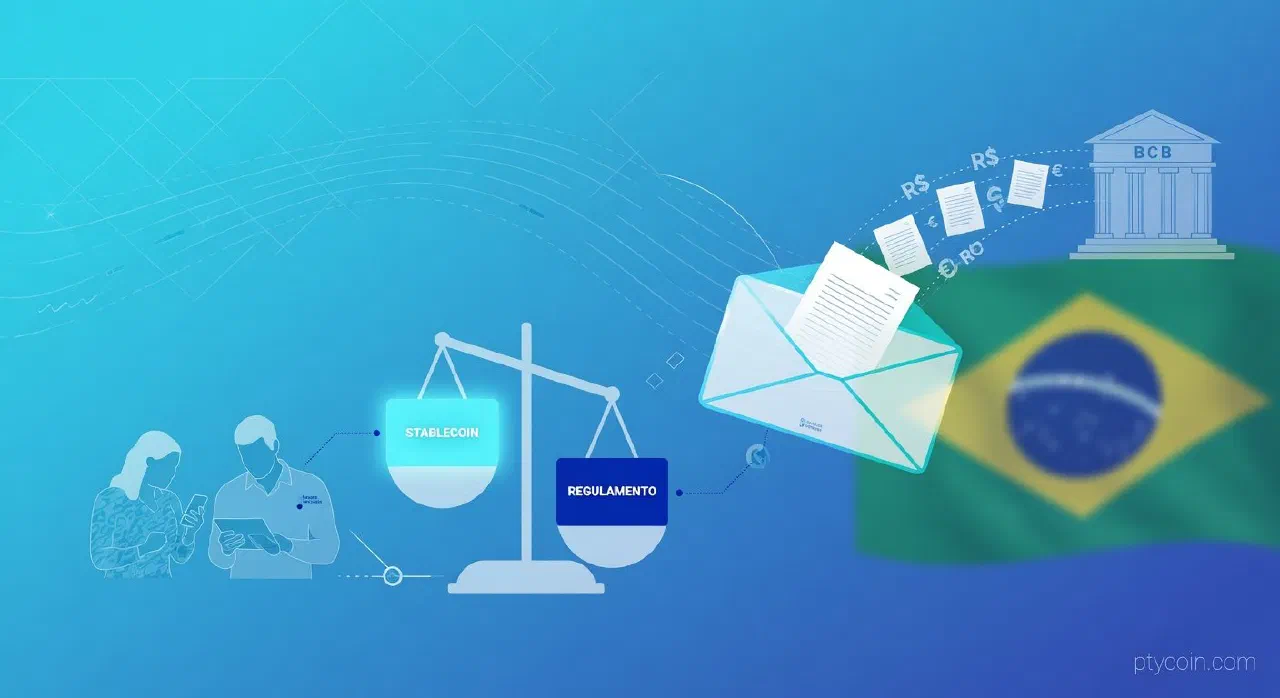
Brazil’s Central Bank has closed one route for using stablecoins in cross-border payments inside its regulated electronic foreign exchange (eFX) system.
Resolution BCB No. 561, published April 30, 2026, requires that settlement between an eFX provider and its overseas counterparty occur exclusively through traditional foreign exchange operations or non-resident BRL accounts. Virtual assets are no longer permitted in that specific flow. The rule takes effect October 1, with adaptation deadlines stretching into 2027.
What this means in practice
A Brazilian remittance fintech or payment firm that accepts reals from a customer, converts them into a stablecoin such as USDT or USDC, and settles the value abroad on a blockchain can no longer do so under the eFX regime after October. The offshore leg must now use conventional banking rails or a non-resident real-denominated account in Brazil.
This is not a general ban on cryptocurrency or stablecoins. Individuals remain free to buy, hold, transfer, and withdraw digital assets. Licensed Virtual Asset Service Providers (VASPs) — the firms authorized under Brazil’s new crypto-specific rules — continue to have a supervised channel for cross-border stablecoin activity.
Background: eFX, stablecoins, and why the rails mattered
eFX is the Central Bank’s framework for authorized payment institutions, e-money issuers, and acquirers to offer digital international payments, purchases, withdrawals, and transfers. It was meant to formalize and oversee more of the cross-border volume that was previously informal or expensive.
Stablecoins — digital assets designed to maintain a stable value against the US dollar or another fiat currency — became attractive for the back-end settlement leg because blockchain transfers can run 24/7 with lower fees and without correspondent banking delays. In Latin America, where remittance corridors often face high costs and slow processing through traditional banks, these rails offered a practical alternative for moving value across borders.
The larger VASP framework now shaping the market
The eFX change builds on the broader regulatory structure the Central Bank put in place last year. In November 2025, the BCB published Resolutions 519, 520, and 521. These rules implement the 2022 Virtual Assets Law, designate the Central Bank as the primary supervisor for most virtual asset activities, and took effect February 2, 2026.
Key requirements for authorized VASPs include:
- Minimum capital requirements between roughly R$10.8 million and R$37.2 million (approximately $2 million to $7 million USD), depending on the scope of services and associated risks.
- Three license categories: intermediaries (wallets and portfolio services), custodians (holding private keys), and brokers that combine both functions.
- Strict segregation of client assets from the firm’s own funds, with individualized account records for each customer.
- Monthly proof-of-reserves attestations and full independent audits at least every two years.
- Robust AML/CFT programs, cybersecurity controls, governance standards, and ongoing reporting to the BCB.
- Treatment of stablecoin-related cross-border activity as foreign exchange operations under BCB oversight.
Foreign platforms that want to continue serving Brazilian customers must obtain authorization within a 270-day window after the February effective date or stop soliciting business and help clients move assets to authorized providers.
Domestic operators generally had a filing window running into late October 2026 while meeting interim conditions.
The framework also prohibits Brazilian VASPs from offering algorithmic stablecoins that lack adequate fiat backing and bars privacy coins such as Monero and Zcash.
Self-custody and reporting obligations
Users of licensed exchanges can still request withdrawals to self-custody wallets they control. However, the provider must identify the owner of the destination wallet and report that information to the Central Bank. Privacy advocates have flagged this as reducing the anonymity previously associated with self-custody withdrawals.
The rules do not prevent individuals from using non-custodial wallets directly for peer-to-peer transfers or from interacting with decentralized protocols — those activities sit outside the intermediary licensing perimeter.
What Resolution 561 changes for eFX providers specifically
For firms operating purely under the eFX rules (rather than the VASP + FX track), the new resolution adds operational mandates: segregated client-fund accounts, monthly reporting through the BCB’s foreign exchange systems, and transaction record-keeping for ten years. The stated purpose is improved traceability and stronger defenses against illicit finance.
Companies already providing international payment services without full BCB authorization may continue on a transitional basis but must apply for the required approvals by May 31, 2027. Already-authorized eFX institutions must update their registrations in the Central Bank’s Unicad system by October 30, 2026.
Crucially, the rule creates a regulatory fork. Entities that qualify as VASPs (including some banks) can route cross-border value using stablecoins inside the integrated VASP/FX regime. Pure eFX fintechs that are not licensed in the virtual asset track lose that option for settlement with foreign counterparties.
Why Latin America cares
Cross-border payments and remittances remain economically essential for families and small businesses throughout the region. High traditional fees and slow settlement have long made lower-cost digital alternatives attractive, especially on corridors connecting Brazil, Argentina, and other neighbors where capital controls or banking frictions have pushed users toward stablecoins.
Brazil ranks among the world’s highest crypto-adoption markets. Reported crypto transaction volumes reached 227 billion BRL (roughly $43 billion) in the first half of 2025, with USDT representing about two-thirds of that activity.
When one set of licensed intermediaries loses access to crypto settlement rails, users and competing providers shift volume elsewhere: to licensed VASPs that retain the capability, to direct on-chain movements, or to P2P arrangements. The policy does not eliminate stablecoin use for international value transfer; it channels more of the activity through entities that meet the higher prudential and supervisory bar.
For Argentines, Paraguayans, or Bolivians who have relied on Brazilian or regional fintechs using efficient stablecoin rails, the October 1 date marks a point where some services may adjust pricing, speed, or availability — or migrate their operations onto the VASP track if they can meet the capital and compliance thresholds.
The practical takeaway
Brazil is choosing deep integration of crypto activities into its existing financial regulatory system rather than a lighter parallel regime. The combination of capital floors, asset segregation, regular audits, proof-of-reserves, and reporting is intentionally demanding. Officials have pointed to technology and money-laundering risks as justification for the rigor.
The likely result is consolidation. Smaller or thinly capitalized players face a steep climb; well-resourced banks and established exchanges are better positioned. For users who value self-custody and efficient borderless transfers, the licensed VASP channel provides a continuing on-ramp, and non-custodial tools remain available outside these rules.
If you send or receive money across borders using Brazilian or regional services, check whether your provider operates under the eFX rules, the VASP regime, or both — and confirm how (or if) their settlement methods will change after October. Self-custody gives you an independent option that sits outside intermediary restrictions.
Rules evolve and enforcement details matter. This article summarizes publicly reported policy developments for informational purposes. It is not legal, tax, or financial advice. Always verify the latest official texts on the Banco Central do Brasil website and consult qualified professionals for decisions that affect your finances or business.
Primary sources
- Banco Central do Brasil, Resolution BCB No. 561 (30 April 2026).
- Banco Central do Brasil, Resolutions 519, 520 and 521 and related norms (November 2025).
- Supporting coverage from Crypto Briefing (May 2026), Forbes (November 2025), and Ledger Insights reporting on the two-track framework.