America’s largest banks are going on the blockchain offensive — on their own terms. On June 5, 2026, a coalition including JPMorgan Chase, Bank of America, Citigroup, and Wells Fargo unveiled a shared network to clear and settle tokenized commercial bank deposits around the clock, operated by The Clearing House. The target launch is the first half of 2027. For LatAm users who already live on USDC and USDT, the move is less about replacing stablecoins tomorrow and more about who controls the dollar rails of the future.
Context: deposits vs. stablecoins
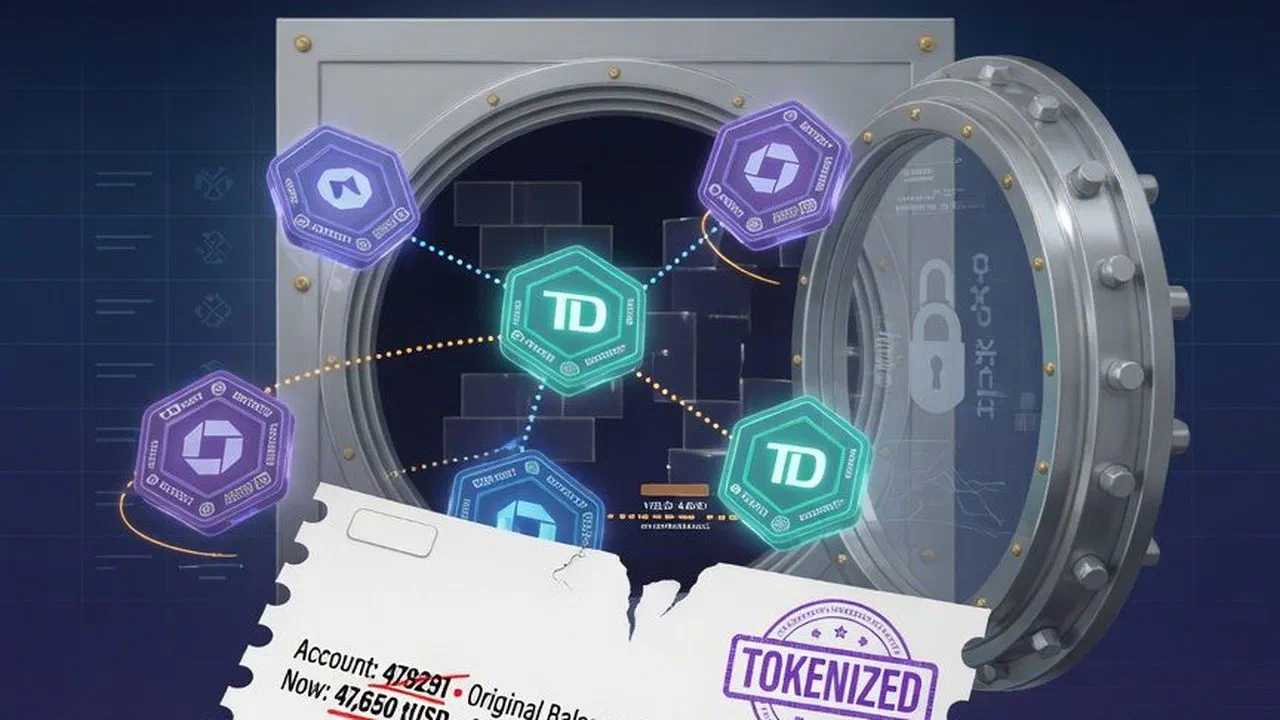
A tokenized deposit is not a new cryptocurrency you buy on an exchange. It is a digital representation of money you already hold in a regulated bank account — a claim on commercial bank money that can move on blockchain rails while staying inside the banking system’s balance sheet and deposit protections.
Stablecoins like USDC and USDT work differently. Issuers mint tokens backed by reserves; users hold them in self-custody wallets or on exchanges, outside traditional bank deposit frameworks. That model has exploded in emerging markets where dollar access, speed, and 24/7 settlement matter more than branch banking.
US banks have watched stablecoin supply grow into the hundreds of billions of dollars and worried about deposit drain — customer funds leaving insured accounts for yield-bearing or payment-friendly digital dollars. The new initiative is a coordinated response: keep the programmability and speed of on-chain money, but anchor it in bank-led infrastructure.
What was announced
The Clearing House announced the initiative on June 5 via press release, describing a landmark payments build that connects on-chain activity with established fiat rails.
The network will deliver two core capabilities:
- On-chain clearing and settlement of tokenized deposits between banks within the existing banking framework — supporting automated workflows, richer transaction data, and 24/7 settlement.
- A connectivity layer linking blockchain-based activity to traditional networks such as RTP (real-time payments) and CHIPS (large-value wire settlement), so value can move between digital and conventional commercial bank money.
Participating institutions span the US banking core: Bank of America, BMO, BNY, Citi, Citizens, Fifth Third, HSBC, Huntington, J.P. Morgan, KeyBank, PNC, Regions, Santander (via Getnet Platforms), TD Bank, Truist, U.S. Bank, and Wells Fargo, among others. CoinDesk reported that the shared network is slated for mid-2027, citing the Wall Street Journal.
Quoted use cases in the release read like a corporate treasury wish list: programmable treasury operations, real-time liquidity management, cross-border payments, agentic commerce, digital-asset settlement, and automated financial workflows. Citi’s Shahmir Khaliq tied the build to live products like Citi Token Services and the rising volume of tokenized securities — arguing the industry needs shared clearing infrastructure before cash and securities can move interoperably on-chain at scale.
The Clearing House is not a startup experiment. The payments company is owned by 25 of the nation’s largest financial institutions and already clears more than $2 trillion daily across wire, instant payment, ACH, and check networks. It launched the RTP network in 2017, giving US banks a real-time settlement backbone. This initiative extends that institutional playbook to tokenized deposits.
Why banks are moving now
The timing is not accidental. Stablecoin legislation and market structure have moved from fringe debate to boardroom priority in Washington. Circle’s USDC and Tether’s USDT dominate global dollar-token liquidity; fintechs and crypto exchanges offer faster settlement than legacy correspondent banking for many corridors.
Banks framing the project emphasize keeping funds inside the regulated perimeter — preserving credit intermediation, KYC/AML controls, and the settlement certainty of commercial bank money. Tokenized deposits inherit deposit insurance and bank balance-sheet backing in ways public stablecoins do not.
Technically, the bet is interoperability without surrendering control. A shared clearing layer means JPMorgan and Citi can settle tokenized dollars between themselves without forcing every counterparty onto a single public chain or a single issuer’s token. That is infrastructure politics as much as engineering: Wall Street wants blockchain benefits without ceding the payment stack to non-bank issuers.
The LatAm angle
Latin America will not plug into this network on day one. The Clearing House build is US-market infrastructure for regulated banks. But the region should watch closely — for three reasons.
First, stablecoins are already LatAm’s practical dollar layer. Brazil and Argentina rank among the world’s heaviest stablecoin markets; users reach for USDT and USDC when local currency volatility, capital controls, or slow wires make bank dollars hard to use. A bank-token network in New York does not automatically give a freelancer in Medellín or a merchant in São Paulo a better on-ramp. Until local banks and exchanges integrate — and until off-ramps to pesos and reais improve — the tools people actually use will keep winning.
Second, Santander’s participation matters. The release quotes José Luis Calderón, CEO of Getnet Platforms (a Santander company), supporting the initiative as a bridge between on-chain capability and existing financial infrastructure. Santander is a major retail and commercial bank across Brazil, Mexico, Chile, and Spain. If parent-group infrastructure standardizes on tokenized deposits for corporate treasury and cross-border flows, LatAm subsidiaries could eventually inherit those rails — especially for B2B payments and merchant settlement, Getnet’s home turf.
Third, cross-border payments are explicitly in scope. Remittance corridors and trade finance are pain points across the region. If tokenized bank deposits connect to RTP/CHIPS on one end and to international correspondent networks on the other, the corporate side of remittances could get cheaper and faster long before retail users see a difference. Households that depend on self-custodied stablecoins for savings and small transfers may see little change near term — which is a self-custody story as much as a banking one.
The competitive frame is clear: banks want programmable dollars they issue and clear; crypto-native issuers want programmable dollars anyone can hold in a wallet. LatAm has already voted with volume for the latter. This announcement is the regulated system’s counteroffer — credible, slow-moving, and aimed first at institutional flows.
Takeaway
On June 5, America’s banking establishment committed to a shared, Clearing House-operated network for tokenized deposits, with broad support from JPMorgan, Citi, Bank of America, Wells Fargo, and more than a dozen peers. The goal is 24/7, on-chain settlement that links back to RTP and CHIPS — live by mid-2027 if timelines hold.
For PTYcoin readers in Latin America, this is infrastructure news, not a product launch. Stablecoins remain the region’s default digital dollar for everyday hedging and payments. The longer-term question is whether bank-token rails eventually offer a regulated alternative with better local off-ramps — or whether they stay a US corporate-treasury story while self-custodied USDC and USDT keep serving the street.
Either way, the fight over who mints the programmable dollar just entered a new phase. Watch who integrates first, and whether Santander’s LatAm footprint turns a US clearing project into something merchants and treasurers here can actually use.
Not financial advice. Tokenized deposits and stablecoins carry issuer, counterparty, and regulatory risks that vary by jurisdiction. Do your own research.
Sources: