
The Inter-American Development Bank (IDB) is running a pilot that could reshape how money moves across Latin America and the Caribbean — not with bitcoin in your wallet, but with tokenized central bank money on shared rails that skip the usual dollar-and-correspondent-bank detour. Regional central banks, including Brazil’s, are watching closely as testing ramps up in the second half of 2026.
Context: why cross-border still hurts
If you have ever sent a remittance from Miami to Bogotá, or paid a supplier in another LatAm country, you know the friction. Transfers often bounce through correspondent banks, convert through the US dollar as a bridge currency, and take hours or days to settle. Fees stack at each hop.
That structure is not an accident — it is how the global payment system was built. For households sending money home and for small exporters invoicing in local currency, the cost and delay are real. Stablecoins and crypto rails have filled part of the gap in recent years (PTYcoin has covered Brazil’s tightening of that path separately), but regulators and multilateral institutions are also building institutional alternatives.
Enter CBWeb3.
What CBWeb3 actually is
CBWeb3 is an IDB Lab initiative — the innovation arm of the IDB — backed by a $750,000 technical cooperation project approved in December 2024 and now in implementation. The goal: a regional test network where each participating central bank can issue its own tCeBM (tokenized central bank money) while preserving national monetary sovereignty. This is not a single shared LatAm currency.
Valor International reported on June 8 that the pilot focuses on cross-border payments, tokenized foreign exchange, and settlement in a testing environment — a narrower scope than Brazil’s shelved retail Drex CBDC, which the Central Bank scaled back after citing privacy and technical hurdles.
The technical build sits on LNet, the alliance that grew out of the former LACChain ecosystem, with core platform development contracted to Brazilian firms Águila Hub and GoLedger. The project’s open-source coordination hub lives under the Linux Foundation Decentralized Trust and is designed as a digital public good — Apache 2.0 licensed code that other countries could reuse.
Two settlement models on the table
According to the CBWeb3 documentation and Valor’s reporting, the pilot tests two approaches:
Enhanced correspondent banking. This replicates today’s bilateral bank relationships, but settles atomically on-chain using Hash Time-Lock Contracts (HTLC) — a smart-contract pattern that locks funds until both sides of a currency swap confirm. Payment-versus-payment (PvP) settlement reduces the risk that one bank delivers reais while the other fails to release pesos.
Automated market maker (AMM) pools. A more experimental route: commercial banks bridge tokenized central bank money to a shared transnational hub, where algorithmic liquidity pools price currency pairs and execute swaps. Think of it as an institutional FX pool, not a DeFi meme coin farm.
In a worked example from Valor: a Brazilian importer pays a Colombian exporter in tokenized reais, the exporter receives tokenized Colombian pesos, and the conversion happens inside the infrastructure — potentially in minutes instead of the multi-hop correspondent chain.
Privacy is a first-class concern. Marcos Sarres, CEO of GoLedger, told Valor the stack uses zero-knowledge proofs (ZKPs) so only the transacting parties and their respective central banks see sensitive details like liquidity positions and trade sizes — lessons drawn directly from Drex’s struggles.
Who is in, who is watching
Brazil’s Banco Central told Valor it is following the pilot “with interest” but has not maintained active participation. It wants to incorporate relevant lessons and stay aligned with international CBDC discussions — a cautious stance for the region’s largest economy.
Valor also reported that Banco do Brasil was in advanced talks to join tests, though the bank declined to comment when contacted. Other LatAm monetary authorities are monitoring the initiative, per the report. Testing with central banks is expected to advance through the second half of 2026; there is no production launch timeline yet.
On the IDB side, project records show reporting milestones dated June 5, 2026, consistent with the pilot entering its final coding and test phase this year after structuring began in late 2024.
Why LatAm cares
Cross-border flows are the lifeblood of the region’s real economy. Mexico’s remittance corridor alone runs into the tens of billions annually. Brazilian exporters, Argentine freelancers paid in foreign currency, and Caribbean tourism economies all depend on FX that is faster and cheaper than today’s rails.
If CBWeb3 works even in a limited pilot, it offers policymakers a regulated, bank-to-bank path that competes with — but does not replace — the stablecoin workarounds households already use when pesos or reais lose purchasing power. That tension is live: Brazil’s Central Bank is simultaneously tightening stablecoin use in regulated eFX flows while watching an IDB-built alternative mature.
For everyday users, CBWeb3 is not something you will download tomorrow. You will not hold tCeBM in a self-custody wallet the way you hold bitcoin or USDT. But the infrastructure choices central banks make here will shape what rails your bank, fintech, or employer can access for international payments over the next decade — and whether LatAm can reduce dollar dependence in settlement without shutting down the crypto options people already rely on.
Takeaway
CBWeb3 is early, institutional, and deliberately experimental. Still, it is one of the most concrete regional efforts yet to test tokenized central bank money for cross-border FX — open-source, privacy-aware, and built by LatAm developers on LatAm infrastructure.
Watch whether Brazil moves from observer to participant, whether Banco do Brasil joins live tests, and how results compare to the stablecoin and Lightning rails already moving real money across borders. None of this is financial advice — just the plumbing story worth following if you send, receive, or invoice across LatAm.
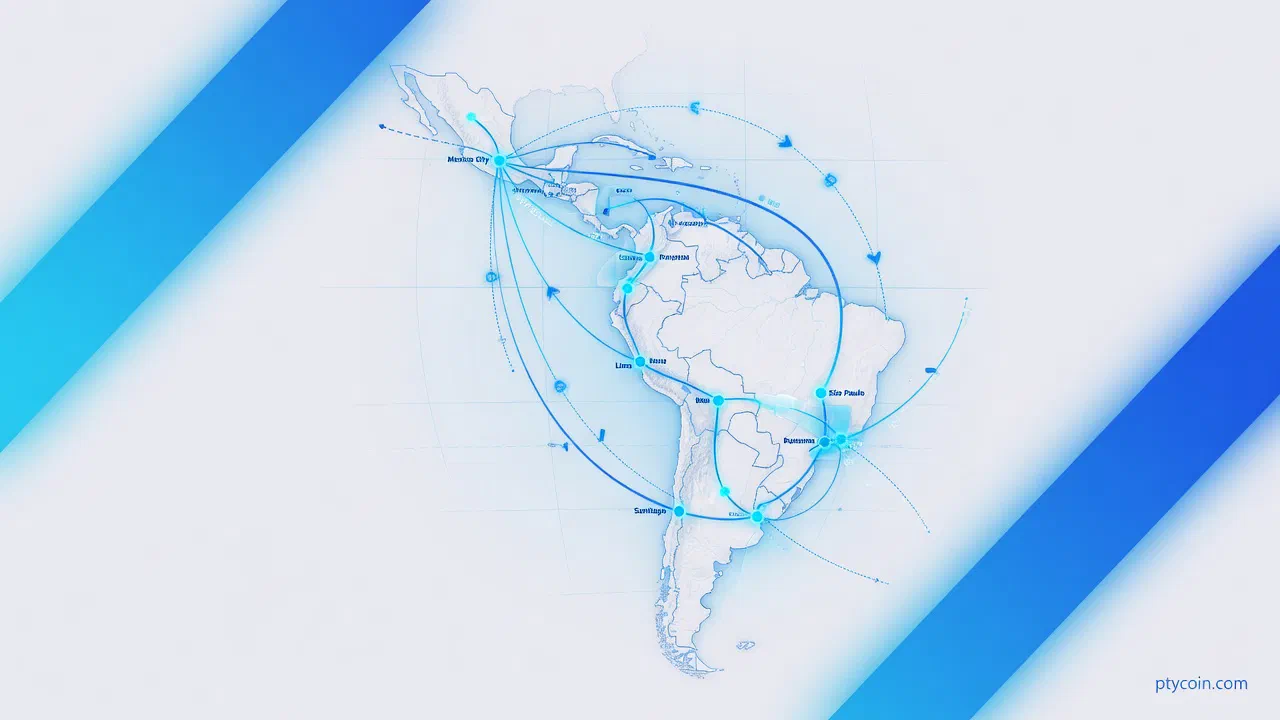
Cover alt text: Editorial map of Latin America with interconnected payment nodes and flowing exchange lines, representing a regional cross-border settlement network.