
Panama’s legislature filed its most ambitious fintech bill in years on January 13, 2026 — and five months later it still has not reached a first plenary debate. Meanwhile, the banking regulator has already tightened the rules that determine whether crypto firms can open or keep local bank accounts.
If you buy, sell, or build with crypto in Panama or use services domiciled there, the split matters: one instrument is still a proposal; the other is already in force.
Context: five failed attempts and a FATF deadline
Panama has tried to pass crypto-specific legislation several times since 2021. The best-known effort — deputy Gabriel Silva’s 2022 “crypto law” — passed the National Assembly but was partially vetoed by then-president Laurentino Cortizo over concerns about money laundering and fiscal transparency.
The new package is broader. On January 13, 2026, deputy Ernesto Cedeño presented Anteproyecto de Ley No. 314, the Ley Marco Integral de Tecnologías Financieras. The National Assembly’s announcement frames it as a comprehensive framework for supervising Virtual Asset Service Providers (VASPs) — firms that exchange, custody, or transfer crypto on behalf of customers — aligned with Financial Action Task Force (FATF) standards. Panama’s next FATF evaluation is expected around 2027, and officials have cited that timeline as motivation.
On January 20, the draft was formally adopted as Proyecto de Ley No. 487, the Ley Marco Integral de Tecnologías Financieras (Fintech) Panamá. As of late May 2026, it remained pending its first debate in the Commerce and Economic Affairs Committee. It is not law yet. Any headline that says Panama “banned” or “legalized” crypto based on this bill alone is ahead of the facts.
What the draft would change
The bill creates three licensed operator categories, each with its own supervision and anti-money-laundering obligations:
- VASP (Proveedor de Servicios de Activos Virtuales): exchanges between crypto and fiat, crypto-to-crypto swaps, custodial wallets, transfers on behalf of clients, and participation in token issuance or sales.
- PSP (Proveedor de Servicios de Pago): payment initiation, processing, or settlement for third parties — covering digital payment processors and aggregators.
- EMI (Emisor de Dinero Electrónico): issuers of stored-value electronic money accepted as payment by parties other than the issuer.
The draft also proposes a coordinating body — the Consejo Nacional de Activos Digitales (CONAD) — to align the Superintendencia de Bancos (SBP), the securities regulator (SMV), the Ministry of Economy and Finance, and the financial intelligence unit (UAF). Licensed operators would appear on a public registry. Administrative fines could reach up to $2 million, depending on severity.
Other notable elements:
- A formal regulatory sandbox for testing innovative products under time-limited, supervised permissions.
- Transitional provisions giving existing operators an adaptation window — widely reported as roughly 18 months from enactment, though the exact clock starts only after presidential assent.
- Enhanced suspicious-activity reporting to the UAF for VASP activity.
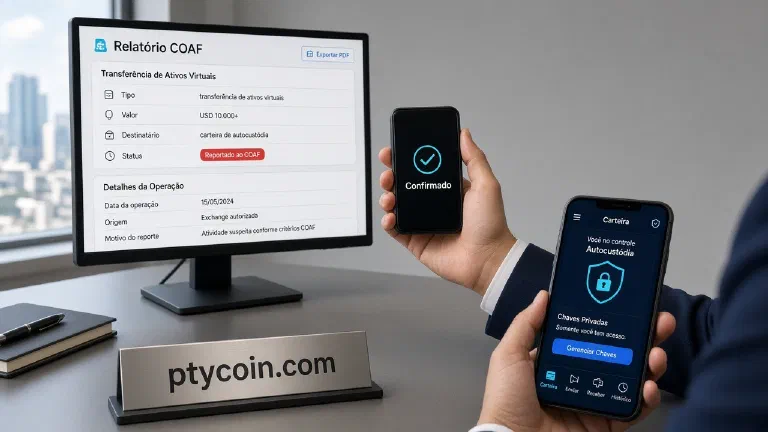
For everyday users, the practical effect of enactment would be clearer rules about which platforms are licensed, stronger customer-protection expectations around custody and segregation, and more standardized KYC (know-your-customer) checks at regulated on-ramps. Self-custody — holding assets in a wallet you control — is not typically prohibited by VASP licensing frameworks; the obligations attach to intermediaries, not to individuals moving coins peer-to-peer or using non-custodial software.
What already changed: SBP Acuerdo No. 1-2026
While the Assembly deliberates, the SBP acted on its own authority. Acuerdo No. 1-2026, titled Prevención del uso indebido de los servicios bancarios y fiduciarios, was published in the official gazette (Gaceta Oficial 30450-A) on January 23, 2026. The full text is available from the SBP.
This is secondary banking regulation — it does not require a parliamentary vote. It consolidates and strengthens documentary requirements banks must collect when opening and maintaining corporate accounts, with heightened expectations for fintech and virtual-asset businesses. Expect banks to ask for:
- Corporate formation records and beneficial-ownership declarations (typically for anyone holding 25% or more).
- Proof of economic activity — business plans, contracts, financial statements or management accounts for startups.
- Written AML/CFT programs, a designated compliance officer, and transaction-monitoring procedures.
- Source-of-funds and source-of-wealth declarations, often notarized.
- Payment-flow diagrams showing how customer funds move from on-ramp through processing to settlement.
The operational impact is immediate. Firms with solid compliance documentation may face slower but feasible onboarding. Operators with generic offshore shells and little demonstrable Panama substance have reported account reviews or closures in the weeks after January — even though Proyecto 487 has not been enacted. Panama deliberately separates primary legislation (Assembly) from banking rulemaking (SBP). The compliance cost arrived before the licensing benefits.
How this compares across LatAm
Panama is not first in the region. Brazil’s virtual-assets framework took effect in 2026 under Central Bank supervision. Uruguay’s Ley 20.345 (2024) integrated VASPs into its central bank regime. Argentina’s CNV maintains a PSAV provider registry. Chile and Mexico have their own layered approaches.
Panama’s draft, read alongside peers, looks closer to Uruguay’s integrated model than to Brazil’s capital-heavy licensing track — but the comparison is provisional until the Assembly finalizes the text. Committee amendments could shift capital requirements, sandbox scope, or the CONAD’s powers substantially between first and third debate.
For regional builders, the signal is directional: Panama wants a FATF-aligned VASP regime and is willing to move banking standards first. Whether it becomes a competitive hub depends on enactment speed, licensing turnaround, and how credibly existing operators transition — not on the draft alone.
Why LatAm cares
PTYcoin started in Panama, and the country remains a transit point for regional crypto volume — offshore structures, dollarized banking, and cross-border payment corridors that connect Brazil, Argentina, Colombia, and Central America. When Panama tightens bank gatekeeping, LatAm fintechs that relied on Panamanian accounts for settlement or treasury operations feel it first.
Three ripple effects matter beyond the border:
- Remittance and payment rails. PSPs and VASPs serving LatAm corridors may relocate banking relationships, pass compliance costs to users, or pursue licenses in jurisdictions with clearer rules.
- Competitive positioning. If Panama enacts Proyecto 487 before neighbors without dedicated VASP laws finish their own frameworks, it could attract operators seeking predictable supervision — similar to how Uruguay drew Argentine firms during regulatory uncertainty. Delay risks the opposite: compliance costs without the public registry and license clarity that attract institutional capital.
- Self-custody as the off-ramp. Stricter intermediary rules do not eliminate on-chain transfers. Users who want independence from exchange risk still have non-custodial wallets and peer-to-peer tools — with the trade-off that regulated on-ramps may demand more identity verification.
Families and small businesses that depend on cross-border payments should watch which category their provider falls into — licensed VASP, payment institution, or an unregulated operator waiting out the transition.
The practical takeaway
Today, the policy delta is asymmetric:
- Proyecto 487 / Draft Law 314: proposed, not enacted. Watch the Commerce Committee for the first debate; calendar slips push realistic enactment toward late 2026 or beyond.
- Acuerdo 1-2026 SBP: in force now. If you run or use a Panama-domiciled crypto business, expect tougher bank due diligence regardless of the bill’s status.
If you are a user, prefer platforms that publish clear licensing status (once a registry exists) and keep custody practices transparent. If you are a builder, start mapping your activities to the VASP, PSP, or EMI definitions and assemble the documentary pack banks already expect under Acuerdo 1-2026. If you value sovereignty over your keys, self-custody remains available outside the intermediary perimeter — but fiat on-ramps will likely get more formal.
Nothing in this draft, as filed, replaces professional legal advice. Bill text can change in committee. This article summarizes publicly reported developments for informational purposes only — not legal, tax, or financial advice.
Primary sources
- Asamblea Nacional de Panamá, announcement of the Fintech framework bill presented by deputy Ernesto Cedeño (14 January 2026).
- Superintendencia de Bancos de Panamá, Acuerdo No. 1-2026 (Gaceta Oficial 30450-A, 23 January 2026).
- Superintendencia de Bancos de Panamá, Acuerdos Bancarios 2026 index.
- Reuters, Panama lawmakers pass crypto bill (2022 veto context).