

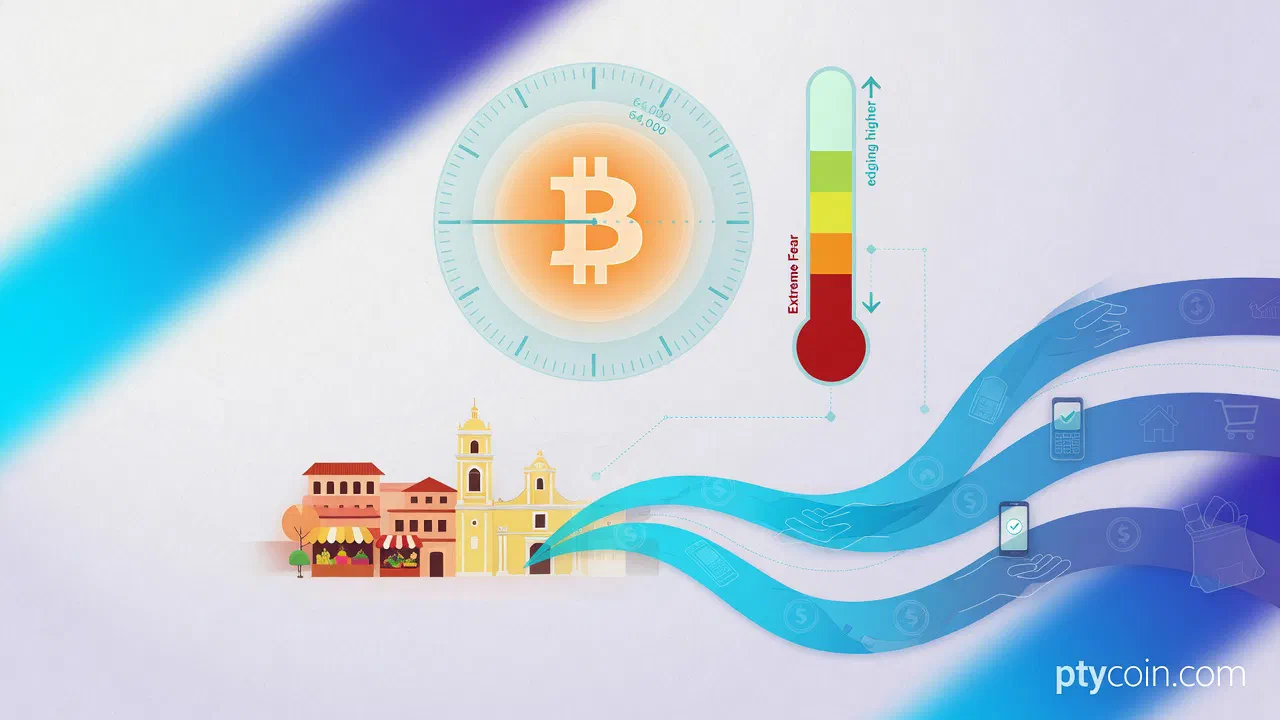
As of approximately 09:31 UTC on June 14, Bitcoin was changing hands near $64,370 on the BTC/USDT pair at Crypto.com Exchange. The latest 1D candle (still forming) showed an open near $64,455, a high of $64,720, a low of $64,226 and last around $64,371, inside a narrow range after the prior session’s close near $64,457. The Crypto Fear & Greed Index has ticked up to 18 from 13 the day before, but remains deep in “Extreme Fear” territory.
Context
The first half of June has been defined by chop after hotter-than-expected U.S. jobs data shifted rate expectations and triggered risk-asset pressure. Bitcoin tested lows near $59,100–$61,500 in the June 5–10 window, then recovered toward the low-to-mid $63,000s and has since consolidated around the $64,000 handle on light weekend flows. U.S. spot Bitcoin ETFs logged an extended streak of net outflows through early June, with cumulative redemptions in the billions according to flow trackers before a modest reversal appeared in the June 13 print.
Sentiment gauges have reflected the defensive posture. The Fear & Greed Index spent multiple sessions in the single digits before the recent crawl higher to the high teens — still firmly extreme fear. Price has shown relative resilience versus some altcoin weakness, yet the lack of conviction in broader positioning keeps the tape cautious even as the immediate macro data shocks of early June fade.
Analysis
Market data from Crypto.com Exchange shows Bitcoin printing an intraday last near $64,371 on June 14, with volume on the pair reflecting typical thin-session conditions. Ether traded near $1,673 in the same window, little changed on the day. The accompanying chart plots BTC price against the Fear & Greed Index over the past eight days using a consistent linear scale for both series.
BTC price vs the Crypto Fear & Greed Index, Jun 7–Jun 14 (Jun 14 intraday as of ~09:31 UTC, not a settled close). Price has held the $64k area while the sentiment gauge has crawled from single-digit extremes toward 18 — still deep fear. Source: Crypto.com Exchange 1D candles + alternative.me.
The June 14 session has so far produced little directional conviction. The prior day’s ETF inflow print (~$86M net, per contemporaneous reports) provided a brief positive signal after weeks of distribution, yet the price response has been a quiet hold rather than a breakout. Fear & Greed’s move from 13 to 18 registers as incremental relief in sentiment but remains far from neutral or greed territory. Observers continue to watch whether any follow-through inflows materialize or whether the modest reversal proves one-off in a still-defensive macro and positioning backdrop.
Why LatAm cares
Global price ranges and the Fear & Greed Index are useful for tracking leveraged and institutional positioning in the largest regulated products. They are not, however, the primary drivers for most crypto activity in Latin America.
On-chain and exchange data have repeatedly shown stablecoins comprising the large majority of fiat on- and off-ramps in key regional corridors — often cited above 90% of crypto-related volume in Brazil and well over half in Argentina. These flows support remittances, merchant payments, freelancer and payroll disbursements, cross-border treasury for businesses, and simple balance-sheet hedging against local-currency volatility. The demand is anchored in day-to-day utility and local macro conditions rather than in any single U.S. ETF flow print or daily swing in a sentiment index.
Infrastructure supporting these uses — local-currency ramps, fintech integrations, on-chain settlement rails — continues to develop on its own cadence. When global risk sentiment is pinned in extreme fear or when ETF channels flip from outflows to small inflows, the volume on regional stablecoin rails does not move in lockstep. Participants using USDT or USDC for actual economic activity experience the tape through access cost, speed, and reliability, not through the beta of a U.S. headline or derivatives gauge.
Takeaway
June 14’s early read shows Bitcoin holding the $64,000 area with only a modest lift in the Fear & Greed Index from recent extreme lows. The prior session’s ETF inflow reversal has not yet translated into broad conviction or a decisive price move; the sentiment backdrop remains cautious.
For Latin America the separation is material. The region’s dominant use cases and volume drivers sit in stablecoin rails that serve real payments, savings, and hedging needs. Those flows have their own persistence and are largely decoupled from the daily narrative of U.S. ETF prints and fear indices. Global risk-asset volatility provides context, not the operating clock.
This is analysis, not advice. Prices move in both directions, ETF flows and sentiment indices are descriptive and subject to revision, single-session data points frequently fail to persist, and regional volume statistics describe observed behavior rather than guarantees of future activity or price outcomes. Readers should do their own research, consider their personal circumstances, and only allocate capital they can afford to lose.
Sources (selected):
- Crypto.com Exchange tickers and 1D candlesticks (MCP snapshot ~2026-06-14T09:31 UTC): BTC last ~$64,371 on USDT (intraday 1D candle open $64,455 / high $64,720 / low $64,226); prior settled closes referenced for chart context. ETH ~$1,673 in same window.
- Chart data and Fear & Greed values via the markets-chart.mjs generator (Crypto.com 1D + alternative.me): Jun 13 close $64,457 F&G 13 (Extreme Fear); Jun 14 intraday ~$64,380 F&G 18 (Extreme Fear, still forming).
- Flow and sentiment reports (June 13–14, 2026) citing the ~$86M net ETF inflow reversal on the 13th and ongoing extreme-fear readings.
- Regional stablecoin share and volume references from TRM Labs, Chainalysis, and Banco Central do Brasil (Brazil corridors routinely ~90%+ stablecoin-related; similar patterns in Argentina and other markets) carried forward from prior coverage.
- Prior session context from jobs data repricing, CPI relief, and cumulative ETF outflow aggregates in early-June 2026 reporting.