
Your crypto in self-custody lives or dies by twelve or twenty-four ordinary words.
Those words — your seed phrase — are the complete backup for the private keys that control your coins on the blockchain. Lose the phrase or let someone else see it and the money can disappear forever. There is no customer support line, no password reset, no bank to call. This guide explains exactly what a seed phrase is, how wallets turn it into spendable keys, and the practical steps that keep it safe.
Not financial advice. A seed phrase gives you full control and full responsibility. One error writing it down, one photo taken “just in case,” or one share with the wrong person and the funds are gone. Practice only with amounts you can afford to lose. Always check the latest instructions from your specific wallet manufacturer.
What is a seed phrase?
A seed phrase (also called recovery phrase, mnemonic, or Secret Recovery Phrase) is a human-readable list of 12 or 24 common words that encodes the master secret for your wallet.
The standard is defined in BIP-39. The wallet generates a large random number (entropy) and maps it to words from a fixed list of 2048 English words. The final word includes a checksum so that a single mistyped word is usually detected when you restore.
- 12 words provide 128 bits of security — sufficient for most users.
- 24 words provide 256 bits — used by some higher-security setups.
The phrase is generated entirely on the device during the first setup of a new wallet. From that single phrase the wallet deterministically derives every private key you will ever need (Bitcoin, Ethereum, stablecoins, etc.) using the BIP-32 / BIP-44 derivation rules. You do not need to back up individual keys; the phrase is the master backup.
The words must be recorded in the exact order shown, with exact spelling. Change one letter or swap two words and you restore a completely different set of addresses — usually an empty wallet.
Generating the phrase the right way
The generation step is when the phrase first appears. Do it only on hardware you trust:
- Buy the device from the official manufacturer site or authorized seller only. Third-party “pre-configured” units have been known to ship with attacker-controlled seeds.
- Initialize in a private location, away from cameras, microphones, or curious eyes.
- Let the device itself generate the new seed. Never type a phrase you made up, imported from a website, or copied from another source into a cold wallet.
- Some devices let you verify the words on the screen before you finish setup. Use that check.
Software wallets on phones or laptops can generate seeds for very small balances or daily spending money, but they are “hot” — connected — and therefore not suitable for long-term holdings.
Writing it down — a deliberate ritual
When the device shows the words, you write. This is not a quick note.
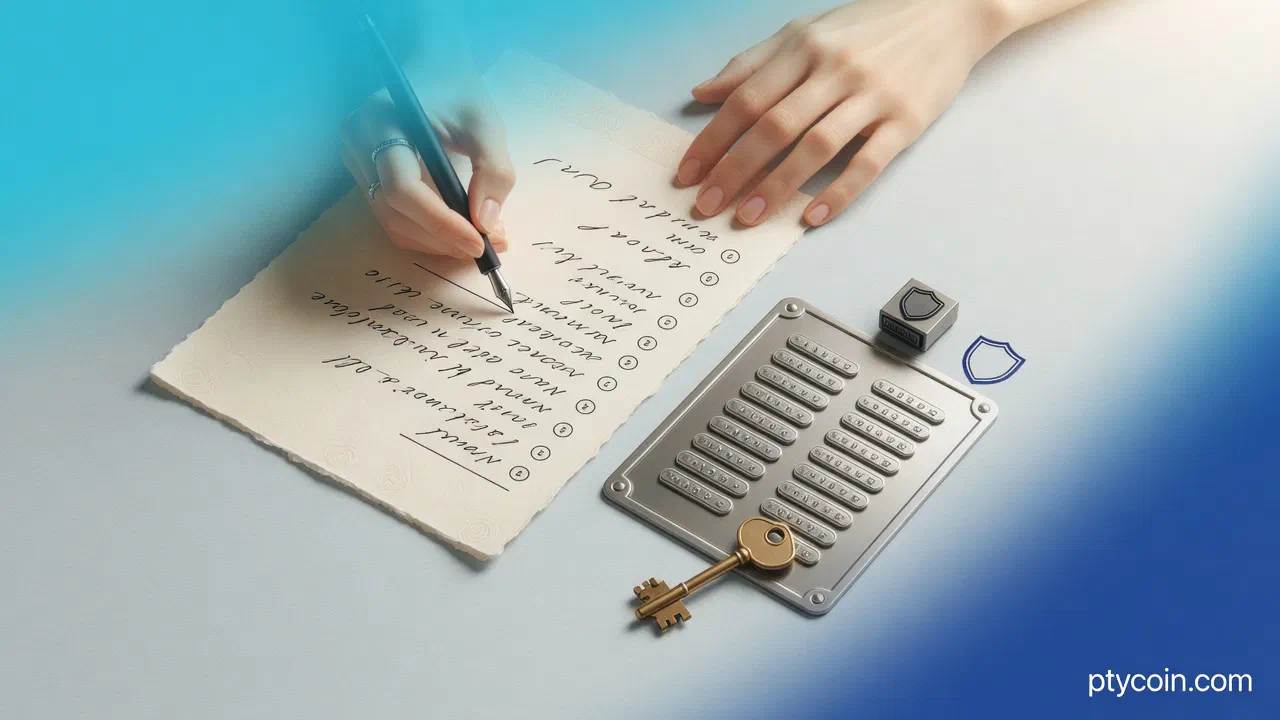
- Prepare your backup medium before you start. Use high-quality paper and permanent ink for a first copy, or better, have metal plates ready.
- Find a quiet, private space. Put phones in another room or power them off.
- Write the number and the word for each position: “1. apple”, “2. banana”, etc. Use clear block letters.
- After writing all words, read them back in order while the device is still displaying the list (or use the device’s built-in verification if available). Fix any mistakes immediately.
- Make at least two physical copies. Three is common for larger amounts.
Never photograph the screen, never dictate into a voice note, never type the words into any app, note, password manager, or cloud document. Digital copies are the fastest way to lose everything to malware, theft, or a future hack of a service you trusted.
Some devices support advanced backup schemes such as Shamir’s Secret Sharing (SLIP-39). In those cases follow the exact share-distribution rules the manufacturer provides; do not improvise.
Storage that actually survives
Paper is convenient but fragile. In Latin America that fragility is practical, not theoretical.
- Paper. Works for a day or two while you arrange something better. Susceptible to fire, water, mold, fading ink, insects, and simple house moves. Humidity and rainy seasons common from the Caribbean to the Andes make long-term paper storage risky.
- Metal plates. Stainless steel or titanium plates that you stamp, punch, or engrave. They survive fire (often to 1400 °C+), flood, corrosion, and crush. Popular options include Cryptotag, Billfodl-style plates, and similar. Once stamped, the words are permanent.
- Split or multi-location. Store copies in separate physical places. A sibling in another country, a trusted non-crypto friend, a home safe, or a discreet everyday object. The goal is that no single fire, flood, theft, or family emergency wipes out every copy.
- Optional passphrase. Many wallets support an extra “25th word” (BIP-39 passphrase). If you use one, the plain 12/24-word seed restores a different wallet (usually with zero balance). You must remember the passphrase separately and never lose it. It adds strong plausible deniability but raises the risk of forgetting access yourself.
Label nothing “crypto” or “seed.” Discretion matters where physical theft or social pressure exist.
The recovery drill — prove it works
Writing the words is not enough. Before you move serious money, test that your written copy actually restores the wallet. For the full dry-run with Ledger Recovery Check, Trezor Check backup, Coldcard, and a spare-device restore, follow how to practice a seed phrase restore.
The short version:
- Use a brand-new or fully wiped spare device (or a testnet software wallet for tiny practice amounts).
- Perform the restore flow exactly as you would in an emergency. Enter the words in order.
- Confirm the device or software shows the receive address you expect (or the small test balance you previously sent to the real wallet).
- Optionally send a dust amount to the restored wallet and confirm it arrives.
- Wipe or factory-reset the test device when done.
If the restore fails or shows the wrong address, you caught the problem while the real funds are still safe. Do this drill calmly on a weekend afternoon. It is the single most important habit after writing the phrase itself.
Fatal mistakes to avoid
- Storing every copy in the same drawer, safe, or house.
- Taking a “quick photo for backup.”
- Entering the phrase on any website, exchange “recovery” form, or unsolicited support chat.
- Buying a second-hand hardware wallet or one from an unofficial seller.
- Rushing the character-by-character check when you are tired or distracted.
- Forgetting that the passphrase (if used) is as critical as the words.
If it feels rushed or confusing, stop. The blockchain does not forgive.
Why this matters in Latin America
Self-custody adoption in the region is driven by real needs: protecting savings from rapid local-currency devaluation, receiving remittances without bank friction, and holding stablecoins when capital controls bite. When more value sits in self-custody, the seed phrase becomes the single point of failure — or the single point of resilience.
Regional conditions add specific pressures:
- Climate and housing. High humidity, coastal salt air, tropical storms, and occasional flooding destroy paper. Metal backups are not luxury; they are the version that survives a rainy season or a move.
- Family geography. Many households already split resources across borders (Argentina–Uruguay, Mexico–US, Colombia–Spain, Venezuela diaspora). A 2-of-3 or 3-card backup naturally fits existing family trust networks.
- Travel and migration. A small stamped metal plate travels more discreetly than cash or a laptop full of files. People moving for work or safety need portable, durable custody.
- Scam surface. Phone and WhatsApp social-engineering attacks that impersonate banks, exchanges, or wallet support are common. The rule “never share your seed” must be absolute, even when the caller sounds official.
- Variable infrastructure. Power and internet can be intermittent. A phrase written on metal does not need electricity or connectivity to remain valid.
None of this replaces manufacturer guidance. It simply means the general best practices have sharper teeth here.
The bottom line
A seed phrase is not a password you can reset. It is the entire wallet. Treat every physical copy as if the coins depended on it alone — because they do.
- Generate only on the device you own.
- Write by hand, verify twice, make durable copies.
- Use metal where humidity or fire risk is real.
- Store copies in separate, reasonably secure locations.
- Test the full restore with a small amount before trusting the backup with real funds.
- Never share the words. Never photograph them. Never type them except during a controlled recovery on trusted hardware.
Do the small test restores. Buy from official channels. Read the manual that came with your device. Update firmware through official apps. And remember the line that matters more than any market cycle:
Your keys, your coins, your responsibility.
A leftover token approval is a different door: a contract can still pull USDC even while the seed stays secret. Walk through Etherscan, Arbiscan, Polygonscan, and Solscan in the token approval checker.