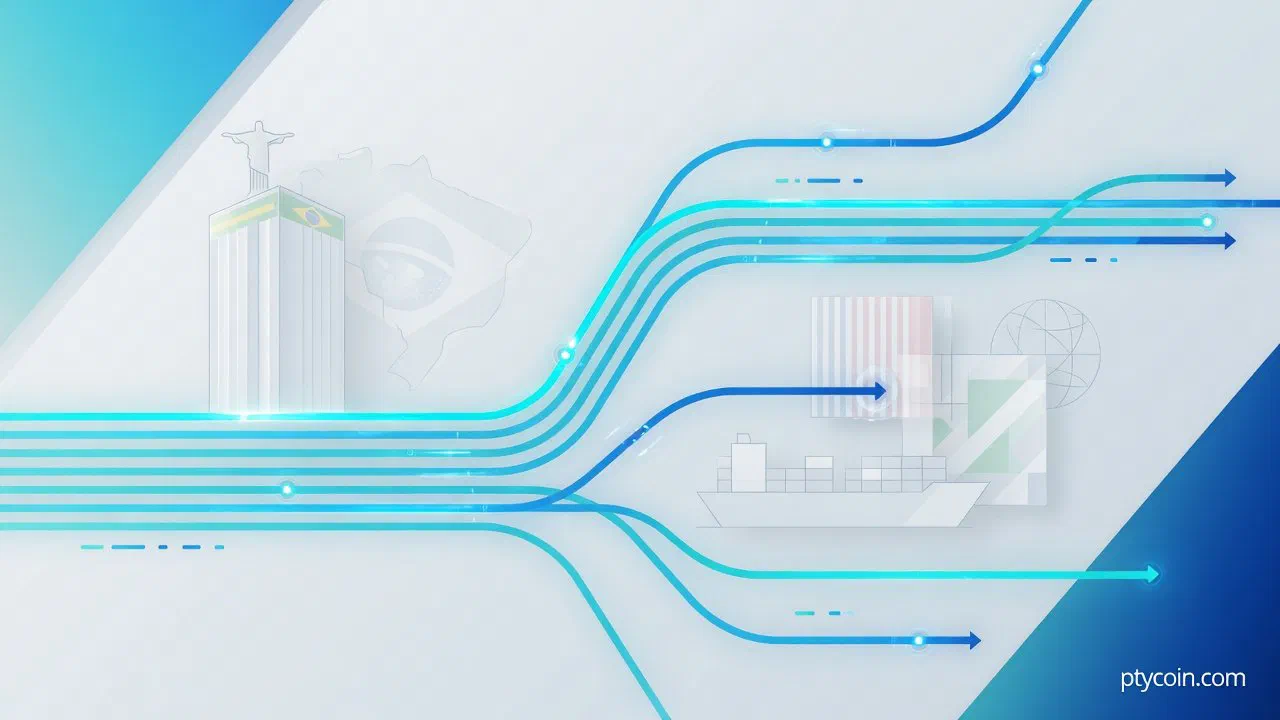
Blockchain.com announced on June 24, 2026, the expansion of its institutional operations into Brazil with a dedicated cross-border liquidity solution for South America’s largest economy. The new infrastructure enables Brazilian businesses to move and settle funds internationally using stablecoins such as USDC and USDT, automatically selecting efficient rails and pairing them with traditional U.S. bank partnerships for USD settlement and routing.
The platform targets corporations dealing with international suppliers, payroll, treasury operations, and cross-border commerce — use cases where traditional wires often mean high fees, multi-day delays, and capital tied up in flight. By blending on-chain stablecoin transfers with bank-grade connectivity, the service aims to deliver near real-time settlement and greater visibility without forcing companies to build crypto treasuries from scratch.
Brazil’s evolving cross-border payments environment
Brazil ranks among the top markets globally for stablecoin activity and digital payments innovation. Local currency volatility, high traditional remittance and trade costs, and growing corporate demand for 24/7 liquidity have driven businesses and individuals toward stablecoins for both hedging and value transfer. Chainalysis and local exchange data have repeatedly shown Brazil posting some of the highest crypto volumes in Latin America, with the vast majority in dollar-pegged assets.
At the same time, regulators have tightened the rails. Recent Central Bank measures reclassify many virtual asset cross-border flows as foreign exchange operations, channeling institutional settlement toward licensed, supervised providers with bank connectivity rather than pure crypto on-ramps. The result is a market that rewards infrastructure players who can operate inside both the banking and blockchain worlds.
Blockchain.com enters this moment citing an established global footprint: more than 95 million wallets created, over 43 million verified users, and more than $1.1 trillion in crypto transactions facilitated since 2011. The company already maintains licenses and registrations worldwide that support third-party payment capabilities. Its institutional arm serves hedge funds, market makers, corporations, and high-net-worth clients with brokerage, liquidity, custody, and market infrastructure.
How the Brazil solution is built
The offering combines direct connections to U.S. banks for USD settlement and international payment routing with the ability to route and settle the cross-border leg in stablecoins. The system automatically chooses the most efficient path for each transfer based on origin, destination, and conditions.
For a Brazilian company paying a U.S. or European supplier, funds can originate in reais or stablecoins, move across borders on-chain where it makes sense, and land in the recipient’s preferred form — all while staying within compliant channels. The same pipes support inbound flows and multi-currency treasury management.
Fabrizio Spada, a financial payments veteran, has been appointed General Manager of Brazil to lead the expansion and trading across Latin America. “We’re seeing growing demand from businesses that want the speed and efficiency of digital assets without the complexity traditionally associated with crypto,” Spada said. “Our role is to provide compliant, secure, and scalable infrastructure that allows institutions to move capital globally with confidence.”
The service is positioned as an enterprise tool rather than a retail product, though it sits alongside Blockchain.com’s broader consumer and institutional offerings.
Why this move now
The timing aligns with two trends: sustained growth in stablecoin usage for operational flows across Latin America, and regulatory pressure that favors integrated providers. Reports have shown stablecoins capturing a large share of cross-border volume in the region because they compress settlement times from days to minutes and reduce reliance on correspondent banking chains that add fees at every hop.
For an established player like Blockchain.com, Brazil represents both a high-volume market and a regulatory proving ground. Success here is intended to serve as a template for rolling similar corporate capabilities to other Latin American countries, deepening the company’s regional corporate footprint.
This is not an isolated announcement. Other infrastructure firms have been layering stablecoin settlement into B2B and payments networks in the region, responding to the same demand for lower-friction cross-border rails. The difference here is the explicit focus on institutional-grade connectivity that bridges legacy banking partners with on-chain settlement.
Why LatAm cares
For businesses operating in or with Brazil, access to efficient dollar liquidity has long been a constraint. Traditional trade finance and international wires impose strict limits, opaque FX spreads, and settlement windows that don’t match global commerce schedules. Companies that buy inputs abroad, sell into export markets, or run regional operations often pre-fund accounts or absorb the cost of delayed capital.
Stablecoin rails change the economics when paired with compliant on- and off-ramps. Near-instant finality frees up working capital. Predictable costs improve margin planning. 24/7 operation removes weekend and holiday cutoffs. For payroll providers supporting distributed teams across borders, or platforms settling with suppliers in multiple countries, the operational lift can be material.
The expansion also has knock-on effects for the broader region. Blockchain.com has stated plans to bring the same cross-border liquidity and settlement capabilities to additional Latin American markets. Corridors involving Argentina, Mexico, Colombia, and others face similar frictions; infrastructure proven in Brazil’s demanding regulatory environment can travel.
Self-custody remains available as a complementary tool. While corporate clients may route through the provider’s platform for the banking integration and compliance layer, the underlying transfers occur on public blockchains. Users and businesses that want to hold and move stablecoins directly in non-custodial wallets can still do so; the new rails simply make it easier to enter and exit those positions when dealing with fiat counterparties or legacy systems.
The takeaway
Blockchain.com’s Brazil launch is a concrete step toward treating stablecoins as production infrastructure for Latin American businesses rather than primarily a trading or personal hedging asset. By securing bank partnerships and focusing on corporate use cases — treasury, payroll, vendor payments — an established crypto company is meeting the market where the regulatory and operational realities now point.
Infrastructure builds like this rarely move spot prices, but they quietly expand what is possible for day-to-day commerce in the region. As more licensed players bridge on-chain efficiency with traditional finance requirements, the cost and speed advantages of stablecoins become accessible to a wider set of companies that previously had no practical way to use them at scale.
Companies and users considering these services should independently review licensing status, custody arrangements, fees, counterparty risks, and compliance obligations. Brazil’s framework continues to evolve, and execution details matter. This article reports publicly announced developments for informational purposes and is not financial, legal, or investment advice.
Sources
- Blockchain.com, “Blockchain.com Announces Expansion into Brazil, Launching Seamless Institutional Payments Infrastructure” (PR Newswire, June 24, 2026).
- Blockchain.com corporate overview, user and transaction statistics, and institutional service descriptions.
- Public statements from Fabrizio Spada, General Manager of Brazil at Blockchain.com.
- Context on Brazil stablecoin volumes and regulatory environment drawn from prior Central Bank resolutions and industry reports (e.g., Chainalysis, local exchange data referenced in public coverage).