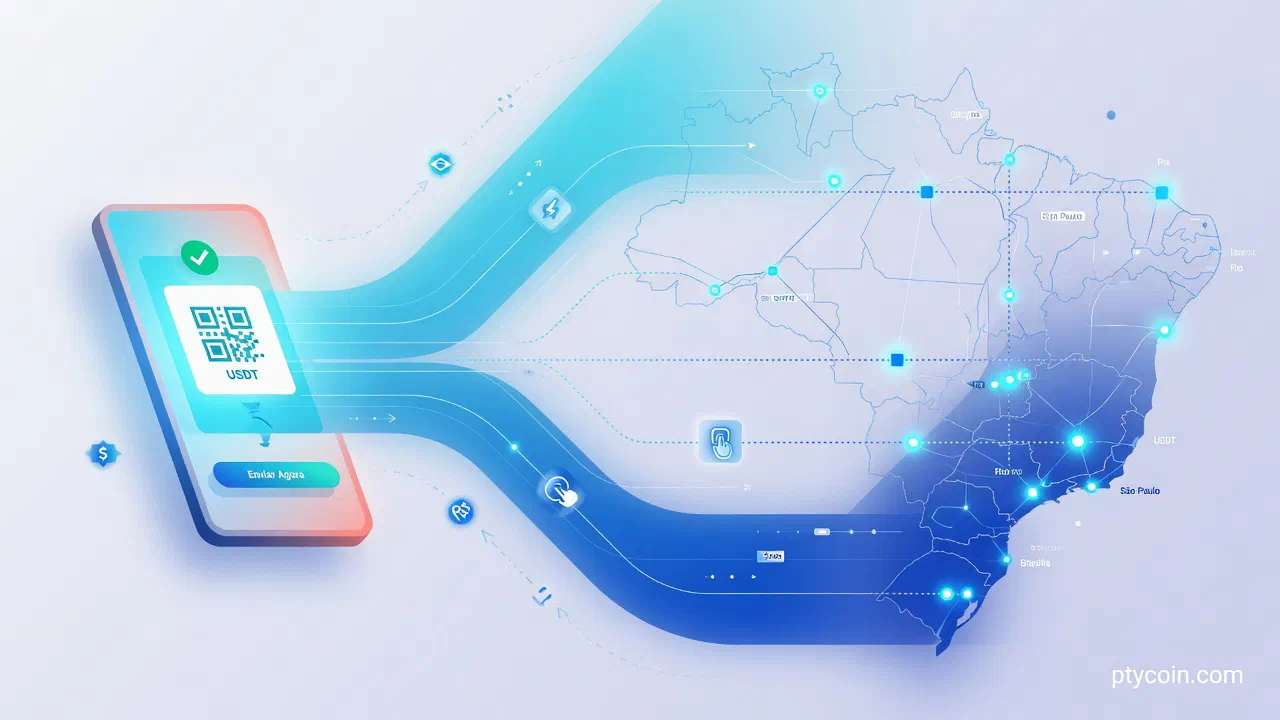
Tether-backed Oobit has launched native integration with Brazil’s Pix instant payment network, allowing users to deposit Brazilian reais directly into USDT balances inside the app and send stablecoins to any Pix key or QR code. Recipients receive funds in reais through the same rails they already use for everyday transfers.
Pix, launched by the Central Bank of Brazil in 2020, now reaches over 170 million users — roughly 80-90% of Brazilian adults — and processes billions of transactions per month with instant settlement and no fees for individuals. The integration makes crypto spending feel like using any banking app while the blockchain runs in the background.
Background on Oobit in Brazil
Oobit, a Singapore-based crypto payments app, entered Brazil in October 2025. It arrived with more than 50,000 pre-launch users and has since reported activity growth exceeding 200%. Average users spend around $400 per month through the platform, with everyday purchases dominating: groceries make up 35% of transactions, followed by restaurants, department stores, and fast food.
During testing, 92% of transactions processed in Brazil were stablecoin spending, and USDT alone accounted for 86% of that volume. The app emphasizes self-custody: users can connect non-custodial wallets such as MetaMask, Trust Wallet, and Phantom to spend directly without first moving funds to an exchange or custodial account.
Oobit is backed by Tether, which led a $25 million funding round for the company. Tether’s involvement has focused on accelerating stablecoin utility in markets with high friction in traditional finance, including Latin America.
How the Pix integration works
Two core flows went live with the June 23, 2026 announcement:
- Deposit via Pix: Users generate a Pix QR code or key inside the Oobit app, pay from their bank app exactly as they would to a friend or merchant, and receive USDT credited to their balance almost instantly.
- Send via Pix: Users enter a recipient’s Pix key, scan a QR, or paste a code, input the amount in reais, and the transfer settles in seconds. The recipient sees the payment in their preferred local currency and account.
The experience mirrors standard Pix in banking apps. No new wallet addresses to manage for the sender or receiver on the fiat side; the conversion and on-chain movement happen behind the scenes inside Oobit.
Oobit also offers a DePay feature for global Visa spending at over 150 million merchants, with cashback, all from self-custody balances. In Brazil the Pix rails add a high-volume local on- and off-ramp layer.
Why this matters now
The rollout follows closely after similar moves by other wallets (Bitget, Bybit Pay, KuCoin Pay) that have added Pix bridges. For Oobit and Tether, it turns a payments app that already saw strong stablecoin usage into one that plugs directly into Brazil’s dominant consumer payment habit.
Brazil ranks among the world’s highest markets for stablecoin activity. With roughly 26 million crypto holders but historically low rates of actually spending those assets, the main barrier was usability rather than access or ownership. By removing the need to learn crypto-specific flows or wait for conversions, the integration addresses that gap at population scale.
Tether’s strategic backing also positions USDT as the default on-ramp and settlement asset for these flows, reinforcing its role in emerging-market payments and hedging.
Why LatAm cares
Pix is the reference implementation for real-time payments in the region. Brazil’s success with instant, low-friction domestic transfers has made it a test bed for bringing crypto rails into everyday money movement. Stablecoins already serve as a practical dollar substitute amid local currency volatility and for cross-border needs.
For Brazilian users and businesses, this means simpler paths to hold and move dollars without leaving the local payment ecosystem: freelancers receiving international pay, families handling remittances, or individuals saving in stable value can now interact with those dollars using tools they already trust.
The model also travels. Other LatAm countries have their own instant rails (SPEI in Mexico, others elsewhere). If Pix integration proves that stablecoin volume grows when the last mile feels invisible, similar bridges will likely appear across the region.
Importantly, the self-custody design keeps users in control of keys until the moment of spend or off-ramp. That aligns with the preference many crypto users in high-inflation or capital-control environments have for not parking funds on intermediaries.
The takeaway
Oobit’s Pix launch demonstrates a concrete route to broader crypto utility: meet people where they already are. Instead of asking Brazilians to adopt new payment apps or interfaces, the service lets the familiar Pix experience carry USDT in and out.
For stablecoin issuers and wallet builders, the lesson is that distribution through existing national payment infrastructure can matter more than raw on-chain features for real adoption. As more competitors add similar connections, Brazil’s 170+ million Pix users become an increasingly direct test of whether stablecoins can move from trading and hedging instruments into routine payments.
This article is based on publicly reported information for informational purposes. It is not financial, legal, or investment advice. Crypto markets, payments adoption, and regulatory environments are subject to change; verify current status directly with Oobit and cross-reference official Pix documentation and local banking rules.
Primary sources
- Oobit official announcement, “Crypto Comes to Pix. Oobit Connects the Digital Dollar to 170 Million Brazilians” (June 23, 2026).
- Crypto Briefing, “Oobit integrates USDT with Brazil’s PIX payment network for 170M users” (June 23, 2026).
- Bitcoin.com News, “Oobit Integrates Pix: How the Tether-Backed App is Bringing USDT to 170 Million Brazilians” (June 26, 2026).
- Additional context from Oobit X posts, Tether funding announcements, and Chainalysis/Bitso reports on Brazil stablecoin volumes (2025-2026).