

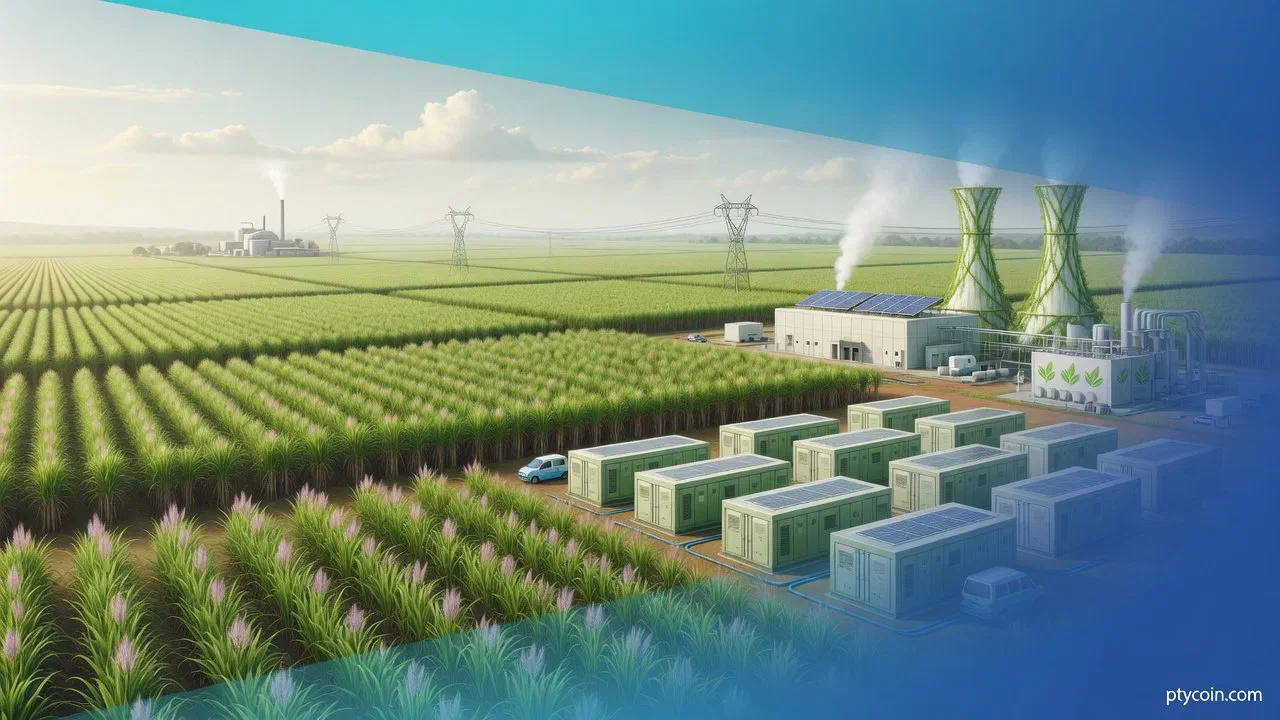
Tether-backed Adecoagro is set to begin Bitcoin mining at a pilot facility in Ivinhema, Mato Grosso do Sul, Brazil, on July 1, 2026 — the start date the company has given for the project. The 10 megawatt site, running on surplus electricity from sugarcane bagasse, deploys approximately 1,280 mining rigs.
The milestone marks the planned shift from announcement to active hashrate production, using energy that sugar and ethanol mills already generate as a byproduct of crushing cane.
Background on the project and partnership
Adecoagro is a South American agribusiness focused on sugar, ethanol, grains, and dairy. Its mills burn bagasse — the fibrous residue left after sugarcane processing — in high-pressure boilers to create the steam and power needed on site. In larger plants this routinely produces surplus electricity beyond internal demand.
Tether holds a majority stake in Adecoagro. In September 2025 the companies signed a memorandum of understanding to explore Bitcoin mining as a use for that surplus renewable power. In early June 2026, Adecoagro project manager Matheus Lechuga outlined the plan at the “Roots of the Future” forum in the region, confirming a July 1 target for the initial phase.
The pilot ties into the Amandina bioelectric plant and benefits from state support in Mato Grosso do Sul for environmental licensing and setup.
How the pilot operates at launch
The first stage deploys 10 MW of capacity and roughly 1,280 ASIC miners. Tether is providing its proprietary Mining OS to manage operations at the site, with plans to open-source the software.
By colocating the mining load directly with the generation asset, the project avoids the need for new long-distance transmission infrastructure. Mining serves as a flexible, controllable demand source that can ramp with available surplus power.
Adecoagro has also indicated that Bitcoin could join its treasury strategy as a long-term holding alongside farmland and commodities.
Biomass mining as a repeatable regional template
Brazil is the world’s top sugarcane producer and already converts bagasse into a meaningful share of its renewable electricity. Directing a portion of that surplus to Bitcoin mining creates local economic activity and technical jobs in interior agricultural states like Mato Grosso do Sul.
For the broader region, the model shows how existing industrial and agricultural energy assets can support Bitcoin network security without new dedicated power plants or direct competition for grid supply. It gives a concrete, home-grown example of sustainable mining tied to real production rather than imported narratives.
Tether’s deep presence in Latin America through USDT for payments, hedging, and remittances now extends into physical infrastructure ownership and Bitcoin production in one of the region’s key agricultural economies. The pilot tests whether biomass-powered mining can scale as a repeatable template for other large mills across Brazil and neighboring countries.
The takeaway
Adecoagro’s pilot demonstrates a practical path for pairing Latin America’s abundant agricultural resources with Bitcoin infrastructure. If the 10 MW pilot proves reliable, similar projects could appear at other mills that already generate surplus power from bagasse or other biomass.
The development keeps value and operations inside the region while adding hashrate secured by genuinely renewable local energy. As with any early-stage infrastructure project, results will depend on execution, power economics, and hardware performance over time.
This article is based on publicly reported information for informational purposes. It is not financial, legal, or investment advice. Crypto markets, mining economics, and energy projects are volatile and carry risk. Verify the latest status directly with Adecoagro and Tether and consult qualified professionals for any decisions.
Primary sources
- Bitcoin Magazine, “Tether-Backed Adecoagro To Launch Sugarcane-Powered Bitcoin Mining In Brazil” (June 3, 2026).
- Livecoins, “Mineração de bitcoin movida a energia de cana-de-açúcar ganha força no Mato Grosso do Sul” (June 2026).
- Adecoagro Investor Relations, “Adecoagro And Tether To Power Bitcoin Mining With Renewable Energy In Brazil” (September 2025).
- Regional updates and forum coverage referencing the July 1 activation (June 2026), including on-the-ground notes on the Amandina plant integration.