
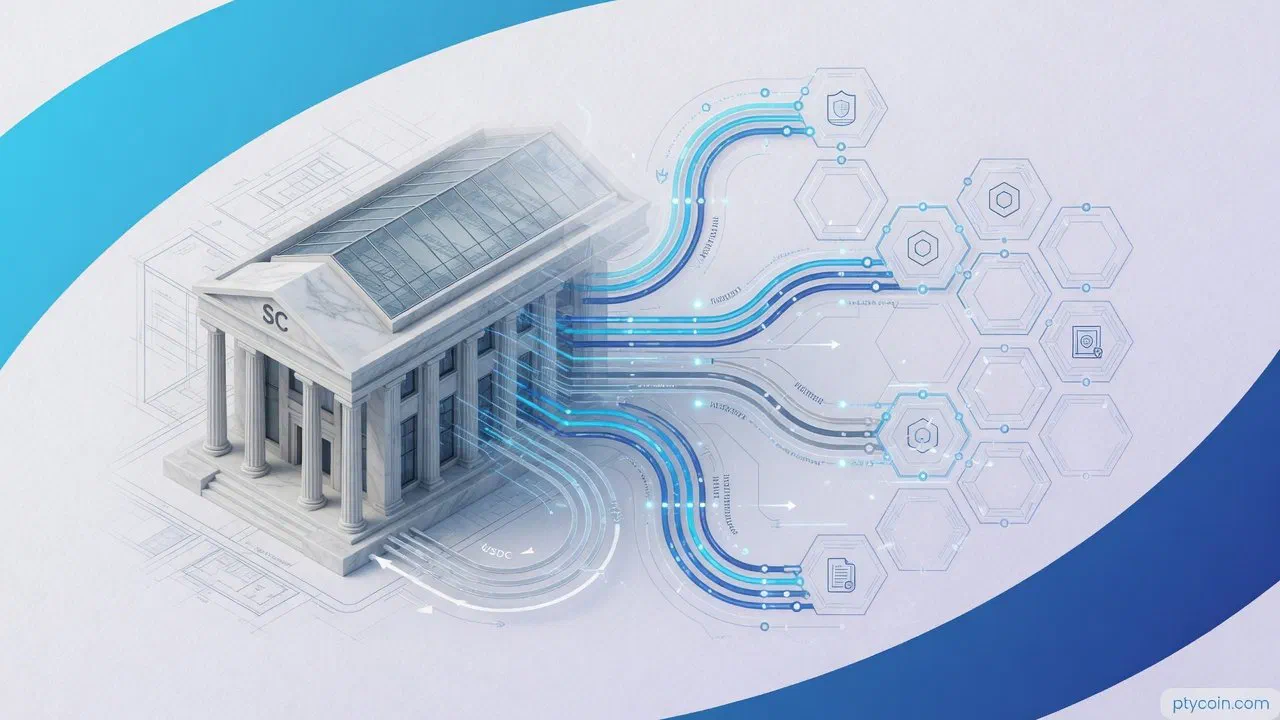
Global banks have stopped debating whether stablecoins belong in finance and started building the pipes to move them. Standard Chartered announced on July 2 that eligible institutional clients can mint and redeem Circle’s USDC through a single bank onboarding — the first time a Global Systemically Important Bank (G-SIB) has offered that capability without forcing clients to open separate accounts with the issuer. CoinDesk reported on July 5 that the industry conversation has shifted from if to how, with lenders positioning themselves as the regulated gateways for on-chain dollar liquidity.
Context: from crypto-native rails to bank-led infrastructure
Stablecoins are digital tokens pegged to a fiat currency — usually the U.S. dollar — and backed by reserves held by the issuer. For years they grew fastest outside traditional banking: crypto exchanges, fintech wallets, and cross-border payment APIs let users move dollar-linked value on public blockchains without a correspondent-bank chain.
That left a gap for large corporations and asset managers. Treasury teams, pension funds, and multinational suppliers often need the compliance, custody, and fiat settlement controls that only a licensed bank can provide. Issuers like Circle built regulated mint-and-burn infrastructure, but many institutions still had to stitch together separate banking, custody, and blockchain accounts to participate.
The latest wave of announcements closes that gap from the bank side. BNY expanded its Circle relationship on June 29, adding mint-and-burn capabilities on top of its role as primary custodian of USDC reserves. Clients can now hold USDC in BNY custody wallets and instruct Circle to convert dollars into tokens — or redeem tokens back to fiat — inside one institutional framework.
Standard Chartered’s launch goes further on distribution. The bank says eligible clients can access USDC minting and redemption through a single onboarding and service experience, without holding direct accounts at Circle. The capability is rolling out first through the bank’s DIFC operations in Dubai, with plans to expand to additional markets as regulators approve.
What the banks are actually building
The product details differ by institution, but the pattern is consistent: embed stablecoin access inside existing banking, custody, and compliance stacks rather than treat it as a separate crypto silo.
Standard Chartered frames the offering around institutional use cases — on-chain settlement, treasury management, and liquidity operations — with payment-related workflows planned for later phases. Roberto Hoornweg, head of corporate and investment banking, said the goal is to extend the “frameworks, controls and regulatory oversight” that underpin traditional markets into digital-asset infrastructure.
BNY’s expanded services similarly combine fiat custody with digital-asset custody so clients can move value across both systems under one operating model. Circle’s Kash Razzaghi described the Standard Chartered integration as giving institutions “compliance, governance, and risk management standards they expect” while accessing blockchain-enabled markets.
CoinDesk’s July 5 analysis notes that several industry executives now argue the competitive value sits in the networks and liquidity around stablecoins — payment rails, treasury plumbing, settlement partners — rather than in the tokens alone. European lenders, meanwhile, are pushing to develop euro-denominated stablecoins so tokenized finance does not default entirely to dollar-backed settlement.
Standard Chartered also secured a MiCA passport in Europe — via Luxembourg’s CSSF on June 25 — a detail that matters as the EU’s licensing deadline reshapes which stablecoins retail platforms can offer. Yesterday’s MiCA enforcement and Revolut’s USDT phase-out show regulation can prune token lists; today’s bank integrations show the compliant side is racing to capture institutional flow.
Bank gateways and Latin America’s stablecoin rails
Latin America did not wait for Wall Street or the City of London to adopt stablecoins. Households, freelancers, and businesses across Argentina, Brazil, Mexico, and beyond already use USDT and USDC for hedging, remittances, payroll, and cross-border supplier payments — often through regional exchanges and fintech APIs rather than global banks.
That grassroots adoption created real infrastructure. Platforms like Bitso, Belo, and cross-border payment providers built on/off-ramps that pair stablecoin legs with local rails such as Pix, SPEI, and QR payments. When a São Paulo exporter pays a Colombian vendor or an Argentine freelancer receives Deel payouts, the stablecoin layer is often already live underneath.
Global bank gateways change the upstream plumbing those regional services connect to. If a multinational treasury team can mint USDC through Standard Chartered or BNY under bank-grade controls, the same tokens can settle into LatAm corridors faster and with clearer audit trails. Corporate clients that previously avoided on-chain legs because compliance teams would not sign off on fragmented vendor setups now have a path that looks like traditional banking — even if the settlement still happens on a public blockchain.
The flip side is concentration. More institutional flow routed through a handful of G-SIBs and MiCA-licensed issuers could deepen reliance on USDC relative to alternatives that lack the same bank distribution — a tension already visible as Europe pushes users away from unlicensed USDT while LatAm platforms still support both. Users who hold stablecoins for savings or payments should understand that bank-integrated minting improves institutional access; it does not replace the need to evaluate issuer risk, custody choices, or whether balances belong in a self-custody wallet versus a bank or fintech account.
Takeaway
The headline shift this week is cultural as much as technical: systemically important banks are productizing stablecoin minting, custody, and redemption instead of treating the sector as experimental. Standard Chartered’s G-SIB-first USDC launch and BNY’s expanded Circle services are concrete steps toward bank-led gateways for on-chain dollar liquidity.
For readers in Latin America — where stablecoins already function as everyday financial infrastructure — the development matters because it connects regional adoption to the regulated global plumbing large institutions trust. That can accelerate B2B settlement and treasury use cases without changing the basic risk calculus: know who holds your keys, which issuer backs your token, and whether your platform will still support it if regulation shifts.
Not financial advice. Stablecoins carry issuer, regulatory, and counterparty risks; bank wrappers add convenience and compliance but do not eliminate them.
Sources