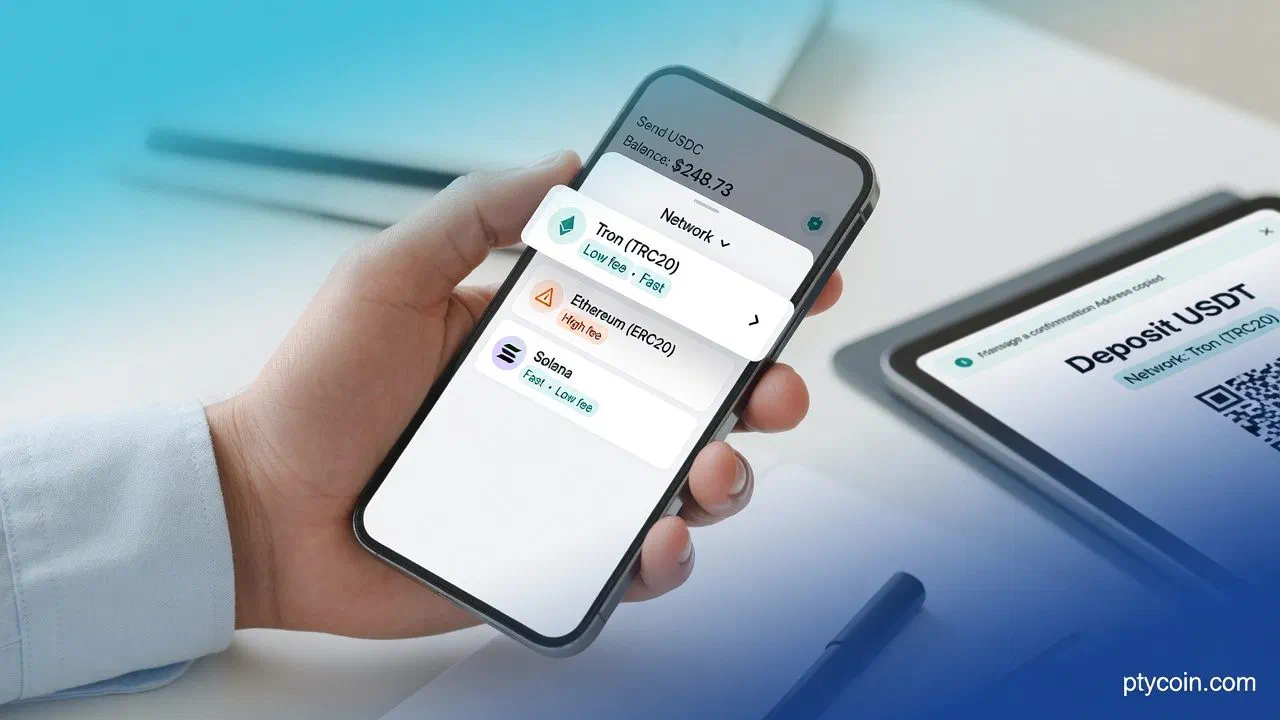
“USDT” on a withdrawal screen is not one product. It is a family of tokens with the same name on different blockchains. Pick the wrong chain and the transfer can confirm on a network your wallet never watches. Support chats rarely reverse that. This guide gives you a decision framework so network choice is deliberate, not a default checkbox.
It pairs with sending safely, receiving safely, and reading a block explorer. Those cover the mechanics. This one answers which rail to use for dollar stablecoins.
Not financial advice. Wrong-network transfers can mean permanent loss. Practice with amounts you can afford to lose. Fees, deposit labels, and supported chains change; always re-check your exchange and wallet before sending real value.
What “network” means for stablecoins
A stablecoin is a token designed to track a fiat currency, usually the U.S. dollar. Tether (USDT) and Circle’s USDC both issue versions on many blockchains. Each chain has its own token standard, address format, fees, and explorers:
| You might see | Roughly means | Common address look |
|---|---|---|
| TRC-20 | USDT on Tron | Starts with T… |
| ERC-20 | Token on Ethereum mainnet | Starts with 0x… |
| BEP-20 | Token on BNB Chain | Also 0x… (different chain) |
| SPL | Token on Solana | Base58 string (not 0x) |
| “Base”, “Arbitrum”, “Polygon”, “Optimism” | Usually an Ethereum L2 or sidechain with ERC-20-style tokens | Often 0x… on that L2 |
The ticker can match while the rails do not. USDT on Tron is not interchangeable with USDT on Ethereum without a deliberate convert or bridge step. The same is true for USDC across Circle’s listed chains.
Family remittances, freelance payouts, and P2P trades across Latin America often default to USDT on Tron because fees stay low and many local exchanges list it. That is a common habit, not a universal rule. The right network is the one both sides support end to end.
The decision framework (use this every time)
Work top to bottom. Stop when a step fails; do not invent a workaround mid-send.
- Name the asset and the network in full. Write “USDT on Tron (TRC-20)” or “USDC on Base,” not “USDT” alone.
- Confirm the recipient can receive that exact pair. Their wallet must show receive for that asset and that network. If the option is missing, pick another pair both sides support.
- Confirm the sender can send that exact pair. Exchange deposit/withdraw menus must list the same label. Screenshots of an old address without the network line are not enough.
- Check native gas. On most chains you need a small balance of the chain’s own coin to move the stablecoin later (TRX, ETH, SOL, BNB, and so on). Receiving USDT with zero gas can leave a balance you cannot spend until you top up.
- Compare fees only after steps 1–4 pass. Cheap is useless if the other side cannot open the funds.
- Agree in writing, then test small when the amount hurts to lose. Confirm the test on the correct explorer before the full amount.
Figure: Only rank fees after asset, network, mutual support, and gas are settled.
Common rails, compared for ordinary transfers
Fee ranges move with congestion. Treat the bands below as order-of-magnitude orientation, then read the live quote on your wallet or exchange before you confirm.
Tron (TRC-20) — frequent USDT default
- Best when: Both parties already use Tron USDT (common for exchange ↔ exchange and P2P in the region).
- Watch for: You need TRX (or enough energy/bandwidth) to send later. Address starts with
T. Verify on Tronscan, not Etherscan. - Avoid if: The recipient only has an Ethereum or Solana wallet with no Tron account.
Ethereum mainnet (ERC-20)
- Best when: You need deepest DeFi / institutional rails, or the counterparty only lists mainnet.
- Watch for: Gas can jump. A “cheap” USDT transfer on a busy day may cost far more than on Tron, Solana, or an L2.
- Avoid if: You are moving a small retail amount and both sides already share a cheaper supported chain.
Ethereum L2s and sidechains (Base, Arbitrum, Optimism, Polygon, and similar)
- Best when: You want ERC-20-style wallets and apps with much lower fees than mainnet. USDC is issued natively on many of these.
- Watch for: The address often looks like Ethereum (
0x…). The network dropdown still has to match. “ERC-20” on an exchange sometimes means Ethereum mainnet only, not “any EVM chain.” - Avoid if: The deposit screen does not list that exact L2. Never assume Base funds appear in a mainnet-only wallet view.
Solana (SPL)
- Best when: Both sides support Solana USDT or USDC and you want very low fees and fast finality.
- Watch for: Addresses are not
0x. You need a little SOL for fees. Confirm on a Solana explorer, not Tronscan or Etherscan. - Avoid if: The exchange deposit only offers TRC-20 / ERC-20 for that asset.
BNB Chain (BEP-20)
- Best when: Both sides already live in that ecosystem.
- Watch for:
0xaddresses again. Selecting BEP-20 when the recipient expected ERC-20 (or the reverse) is a classic mix-up.
Official issuer pages list which chains they support (Tether supported protocols, Circle multichain USDC). Your wallet and exchange still have the final say: an issuer can list a chain that your app has not enabled yet.
Exchange deposit labels: read every word
Exchanges invent short labels. Train yourself to slow down here:
- “USDT-TRC20” / “Tron” → Tron only.
- “USDT-ERC20” / “Ethereum” → usually Ethereum mainnet, not Base or Arbitrum.
- “USDC” with a network picker → open the picker; the default may not be what the recipient uses.
- QR codes encode an address, not always a full network agreement. Still say the network in the chat.
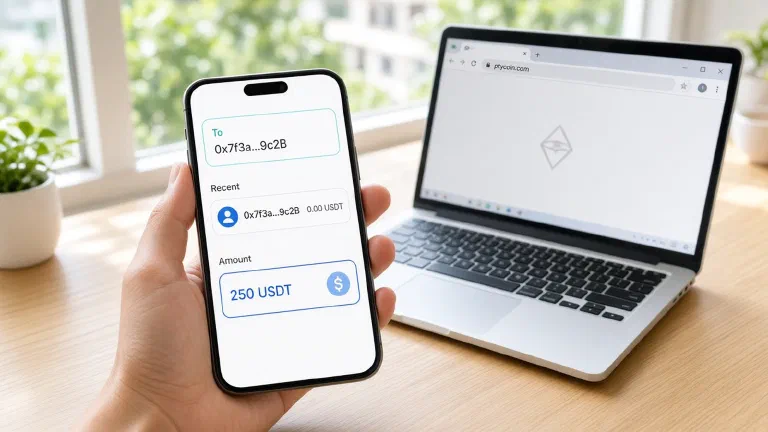
Copy the address from the deposit page after selecting the network, not from an old message. Paste it back character-for-character. For large amounts, send a test first, then the rest only after the explorer shows the funds on the chain you both named.
What not to do when something looks stuck
- Do not “fix” a wrong-network send by bridging immediately. Bridging adds smart-contract and address risk on top of an already broken transfer. First identify where the funds actually landed (txid + explorer on the chain that mined the tx).
- Do not resend the full amount on a second network while the first transfer is unresolved.
- Do not trust a support agent who asks for your seed phrase. Real recovery never needs your recovery words.
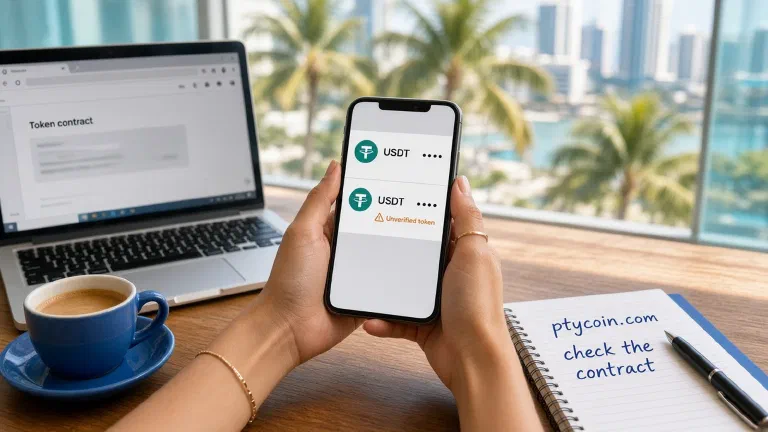
- Do not rely on ticker similarity. USDT ≠ USDC. TRC-20 ≠ ERC-20. Native USDC on an L2 is not the same as a random bridged lookalike token with a similar name.
If the funds arrived on a chain your current wallet does not show, the recovery path (when one exists) is usually: import or open a wallet that supports that chain, verify the address still matches your keys, then decide whether to keep, convert, or carefully bridge. That is advanced. Prefer preventing the mistake.
A practical default for many LatAm retail flows
When both sides are retail users on regional exchanges or P2P desks, USDT on Tron (TRC-20) is often the path of least resistance: wide listings, familiar labels, low fees relative to Ethereum mainnet. When the flow is app-to-app with modern self-custody wallets that already speak Solana or an L2, USDC on Solana or a supported L2 can be cleaner and cheaper.
Neither default overrides mutual support. The correct choice is always:
The cheapest chain that both the sender’s withdraw screen and the recipient’s receive screen list, with native gas available on the receiving side.
One development worth watching: Circle has started engineering this problem away on the USDC side. Its Gateway product gives apps and exchanges a single unified USDC balance they can spend on a dozen-plus supported chains in under a second, with no bridge step and no per-chain inventory. It is plumbing for the platforms you use, not a button in your wallet, so until your exchange or wallet adopts it, the checklist above still decides your transfer.
Checklist you can paste into a chat
Asset: USDT (or USDC)
Network: Tron TRC-20 (or Base / Solana / …)
My address: [paste full address]
Please send a $X test first, then the rest after I confirm on the explorer.
I will not share a seed phrase with anyone.
Adapt the network line. Keep asset and network on separate lines so a screenshot cannot crop one of them away.
Takeaway
Network choice is part of self-custody, not a technical footnote. Name the chain, match both interfaces, plan for gas, rank fees last, and confirm on the right explorer. Do that every time and you remove the single most common way dollar stablecoins vanish between two careful people. When the dollars arrive via Brazil’s Pix rail, walk the full buy-and-cash-out path in how to buy and cash out USDT with Pix.