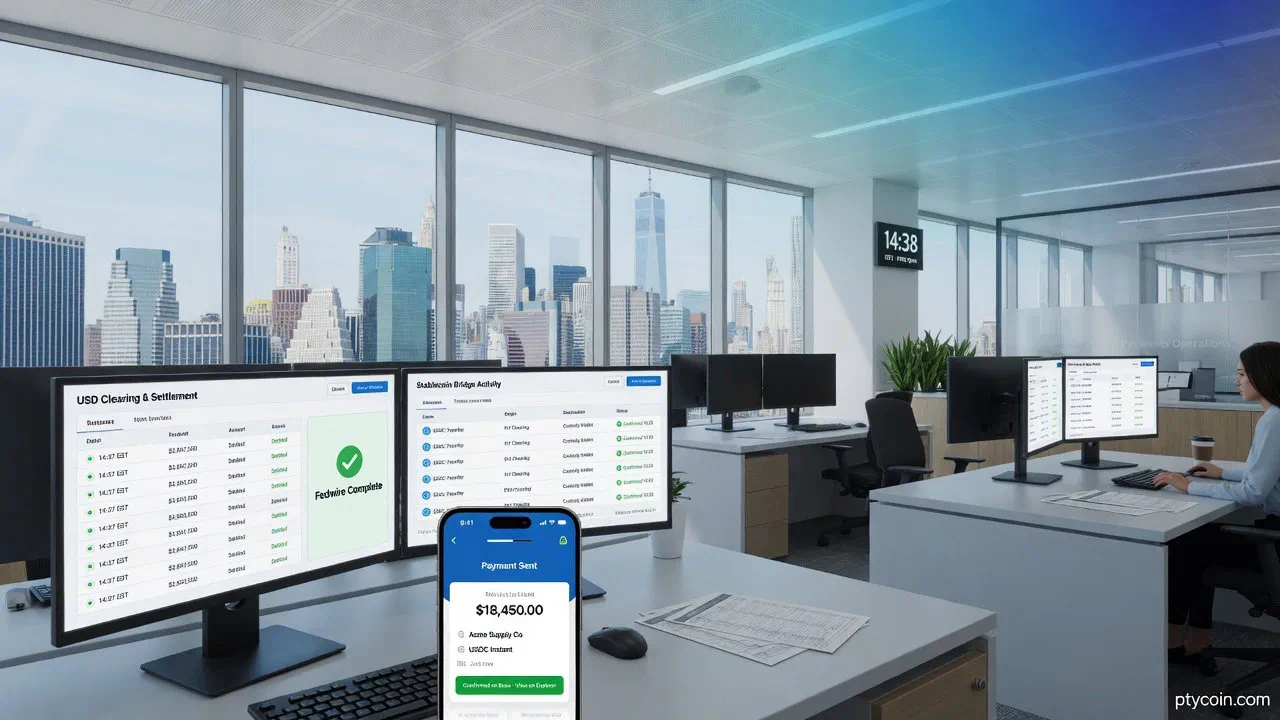
Augustus closed a $180 million Series B at a $1 billion valuation on July 21, 2026, led by Tiger Global, to build what it calls a Global Dollar Bank: a federally chartered U.S. clearing bank for fintechs and banks that need direct dollar accounts and rails, including stablecoins.
The company press release says Hummingbird and QED joined the round, along with founders from Nubank, Ramp, Circle, and Deel. CoinDesk and PYMNTS also covered the round on July 21.
What Augustus is building
Augustus is not launching another branded dollar coin. The product is clearing and account access: operating and for-benefit-of (FBO) accounts with named virtual accounts, so customers can pay first and third parties over Swift, ACH, SEPA, and stablecoins from one platform. That is the company description of the stack, not a claim that every corridor is already live at full scale.
The firm says it will keep investing in Marble, its proprietary core banking system, which it markets as the layer that makes settlement faster and available 24/7/365 by applying AI to back-office work. In earlier materials, Augustus (then rebranding from Ivy) argued that legacy correspondent banking is closed roughly 115 days a year and still settles many flows on multi-day cycles. The new capital is meant to press that thesis into a regulated U.S. bank shell rather than another middleware layer sitting on someone else’s charter.
CEO and co-founder Ferdinand Dabitz put the pitch bluntly in the release: “the Dollar is the greatest product in the world but its distribution is fundamentally broken.” President Greg Quarles, a former bank CEO and OCC official, framed the bet as building the stack from the foundation up instead of patching legacy rails.
OCC conditional approval, not a full open bank
In May 2026, the Office of the Comptroller of the Currency gave organizers preliminary conditional approval to establish Augustus National Bank, N.A. (planned for Dallas). Augustus says it is the eighth bank to receive conditional OCC approval since 2010. Conditional approval is a green light to organize the bank under capital, governance, systems, and other conditions. It is not a final charter that lets the firm accept deposits, lend, or open for full banking business tomorrow.
That distinction matters for readers who skim “bank” in a headline. Until final approval and go-live, Augustus is still assembling federally supervised infrastructure while running existing payment activity. The company says it is already processing billions for market leaders such as Kraken and has raised $210 million total since founding in 2022 (Dabitz, Joshua Becker, Simon Wimmer, and Peter Lieck).
Investor list color is deliberate. Beyond Tiger Global, the release names David Vélez (Nubank), Sean Neville (Circle co-founder), Karim Atiyeh (Ramp), Alex Bouaziz (Deel), Farooq Malik (Rain), and others from fintech and crypto. Nigel Morris of QED called correspondent banking “the last remaining part of the bank stack that hasn’t been challenged yet by fintechs” and argued Augustus pairs a real charter with modern technology instead of forcing firms to choose between slow incumbents and non-bank middleware.
Latin America’s dollar problem is an institutional one
The release is explicit about where Augustus wants the money to work: continue serving fintechs and banks in Latin America, Southeast Asia, the Middle East, and Africa. For LatAm operators, dollar access is not an abstract product category. Remittances, freelancing payouts, e-commerce settlement, and corporate treasury still live or die on how cleanly dollars move between local apps and U.S. rails.
Stablecoins already carry a large share of that pressure. Brazil, Argentina, Mexico, and the corridor economies run heavy USDT/USDC volume because peso, real, and inflation dynamics make a programmable dollar useful even when a local bank cannot open a smooth correspondent path. What remains expensive is the institutional hop: a regional fintech that needs named accounts, compliance-grade FBO structures, ACH/Swift for partners who will not touch a wallet, and stablecoin settlement for the rest.
Augustus is pitching itself as that hop under a national bank perimeter rather than as a stablecoin issuer competing with Circle or Tether. That sits next to other 2026 plumbing stories we have covered: Visa’s enterprise stablecoin platform beta, Circle’s OCC national trust bank path, and network experiments that treat dollar tokens as settlement inventory. Different products, same direction: move the dollar and its tokenized cousins inside regulated operating systems that banks and fintechs can wire into compliance and treasury.
Self-custody is still a separate risk model. A clearing bank that settles stablecoins for Kraken or a LatAm wallet does not turn balances you hold in your own wallet into a deposit-insured product. It can, over time, make it cheaper for the apps you already use to cash in, cash out, and pay merchants without multi-day correspondent delays. That is the user-facing so-what; the Series B itself is wholesale infrastructure capital.
What to watch next
Three milestones will decide whether this round is a branding peak or a real rail:
- Final OCC charter and open for business. Conditional approval is step one. Deposit-taking, lending powers (if any), and full clearing go-live dates are the test.
- Named LatAm customers and volume. The company says the region is a growth target and that Kraken is already on the platform; public client lists and corridor metrics will show whether the LatAm story is sales deck or operating reality.
- How stablecoin settlement is wired. Rails that say “stablecoins” can mean custody-and-redeem, on-chain mint paths, or partner-token support only. Product docs and partner announcements will matter more than Series B copy.
Competition is multi-sided: incumbent correspondent banks, banking-as-a-service sponsors, card networks packaging stablecoin operations, and trust banks aligned with major issuers. Augustus is trying to own the clearing bank niche that sits between those stacks.
Takeaway
Augustus raised $180 million at a $1 billion valuation to stand up a U.S. federally chartered clearing bank that combines classic dollar rails with stablecoin settlement for international fintechs and banks, with Latin America named as a priority customer region. The OCC step so far is conditional organization approval, not a finished open bank. Treat the raise as infrastructure news about who is building always-on dollar access, not as a retail product to buy or a token to chase. Not financial advice.