Short answer: on most chains you cannot pay gas fees with USDT or USDC. Fees are charged in the network’s own coin — TRX on Tron, ETH on Ethereum and its L2s, SOL on Solana, POL on Polygon. Some apps do let you pay fees in a stablecoin, and Tron has its own workarounds; both are covered below, and both are narrower than they sound.
Your USDT arrived. The balance looks right. Then you try to send it, and the wallet refuses: not enough TRX, ETH, or SOL. The stablecoin is real. The fee coin is missing. Until you fix that, the funds sit where you cannot spend them.
This is the most common surprise after a clean stablecoin transfer into self-custody. It is step 4 of picking the right network, expanded into a full practice. Pair it with sending, receiving, and reading a block explorer. Those cover the rails. This one covers the fuel.
Not financial advice. Missing gas does not erase your tokens, but it can strand them until you fund fees. Practice with small amounts. Fee models and wallet UIs change; re-check your exchange and wallet before moving real value.
What “gas” actually is
On almost every chain you use for USDT or USDC, the token and the fee are separate.
- A stablecoin (USDT, USDC, and similar) is a token that tracks a fiat currency.
- Gas (or network fees) is what the chain charges to process a transaction. On most chains that fee is paid in the chain’s native coin: TRX on Tron, ETH on Ethereum and most Ethereum L2s, SOL on Solana, BNB on BNB Chain.
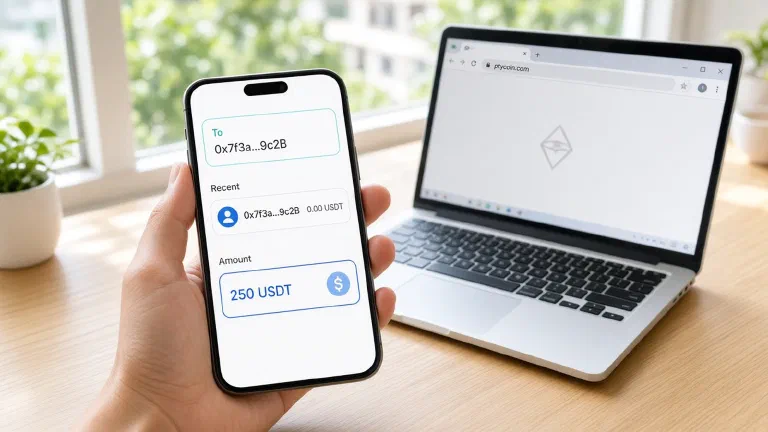
Receiving a token does not require gas on the recipient side. Spending or sending that token usually does. Your wallet can show $500 of USDT and still block every outbound transfer if the native balance is zero.
Think of it as a fuel tank next to a cargo hold. Cargo can fill without fuel. Driving requires both.
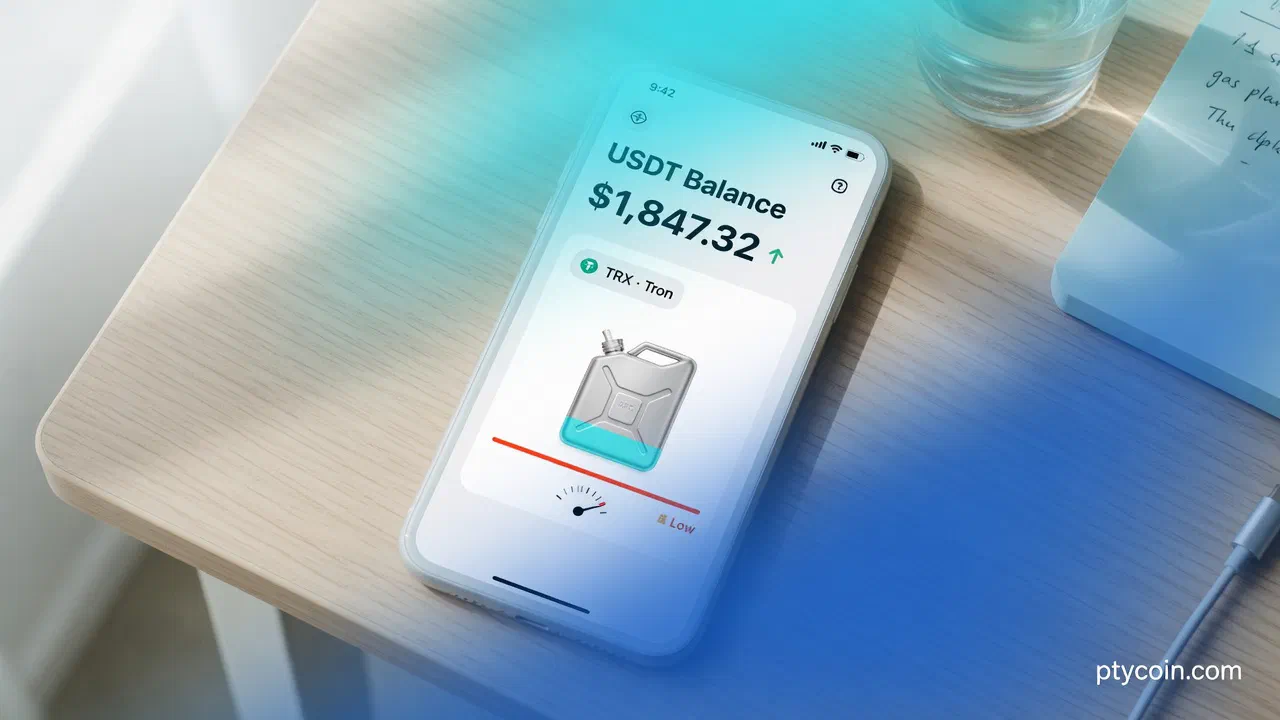
Figure: A full stablecoin balance without native gas cannot leave the wallet on ordinary rails.
Why each chain needs its own gas
Native coins do not transfer across networks the way a nickname does. TRX only pays Tron fees. ETH on Ethereum mainnet does not pay Base fees unless you bridge or hold ETH on Base. SOL only pays Solana fees. Holding “some crypto somewhere” is not a plan.
For family remittances, freelance payouts, and P2P trades that already use USDT on Tron, the practical trap is simple: people withdraw only USDT. The balance looks complete. The first outbound send fails for want of TRX (or staked energy). The same trap shows up with USDC on Base with zero ETH, or SPL USDT with zero SOL.
How much to keep (order of magnitude)
Exact fees move with congestion, token contracts, and whether the destination account is new. Treat the bands below as planning buffers, not live quotes. Always read the fee your wallet or exchange shows before you confirm.
| Chain / rail | Fee paid in | Planning buffer for a few ordinary token sends | Notes |
|---|---|---|---|
| Tron (TRC-20) | TRX (or Energy/Bandwidth from staking) | Often tens of TRX if you burn for Energy; less if you stake or rent Energy | First send to an empty USDT holder can cost more than a later send. Free daily Bandwidth is small; smart-contract USDT sends need Energy (TRON resource model). |
| Ethereum mainnet | ETH | A small fraction of ETH when gas is calm; more when the network is busy | ERC-20 transfers use more gas than plain ETH sends. Check a live tracker such as Etherscan Gas Tracker before large moves. |
| Base, Arbitrum, Optimism, and similar L2s | ETH on that L2 | Often a thin slice of ETH for several transfers | Same 0x shape as mainnet; wrong network still strands funds. ETH on mainnet is not L2 gas until it is on that L2. |
| Solana (SPL) | SOL | A small SOL balance covers many simple transfers | Very low per-tx fees when the network is healthy; still non-zero. |
| BNB Chain (BEP-20) | BNB | A small BNB buffer | Same idea: token ≠ fee coin. |
Rule of thumb: keep enough native coin for several future sends, not one. Top up when the buffer drops to “maybe one try left.” Do not empty the gas tank after every transfer “to clean the wallet.”
If you only use one rail (common: Tron USDT), master that one buffer first. Multi-chain users need a small gas pocket on each chain they actually send from.
Tron in practice (the rail many remittance users already use)
On Tron, Bandwidth covers transaction size and Energy covers smart-contract work. Ordinary TRC-20 USDT transfers consume both. Accounts get a modest free daily Bandwidth quota; Energy has no free quota. If stake and free quota are not enough, the network burns TRX from the sender (official resource docs).
Practical paths:
- Hold spare TRX and let the wallet burn it for fees. Simplest. Keep a buffer so one expensive send does not zero you out.
- Stake TRX for Energy/Bandwidth if you send often. Learn unstake timing in your wallet before locking large amounts.
- Energy rental / marketplaces for heavy senders: reputable venues only, verify destination addresses, never hand over a seed phrase.
Gas-free or “pay fee in USDT” products also appear for Tron. Some are real features inside a specific app. Others are marketing. If a tool wants your seed, unlimited unknown approvals, or a random DM “verify,” stop.
The chicken-and-egg: first gas when you only hold stablecoins
New self-custody wallet, someone sends USDT, zero native coin: every outbound path needs gas you do not have.
Safe, boring solutions:
- Withdraw a small amount of the native coin from an exchange to the same address/network as your stablecoin (TRX on Tron to the address that holds USDT). Use the correct network label.
- Buy a small buffer on an exchange or on-ramp that supports your country, then withdraw to self-custody.
- Ask a trusted counterparty for a small native top-up to your verified address. Confirm the network in writing first (receiving safely).
- Some wallets and apps swap a slice of USDT → native coin inside the product. That only works in that product’s flow. Read the fee quote before you confirm.
Do not paste your seed into a site that promises to “unlock” stranded USDT. You need fees, or a product that sponsors fees. Anyone who needs your recovery phrase is stealing.
Can you pay gas fees with USDT or USDC? Where it actually works
ERC-4337 paymasters let an app sponsor gas or accept fees in a token such as USDC on supported chains. Circle’s Paymaster and Base paymaster guides document this for specific products.
- Inside that app, you may send without native ETH. Product feature, not a universal chain rule.
- Outside it, classic seed wallets (MetaMask, many hardware setups, standard Tron/Solana) still need the native coin.
- Never assume “I paid gas in USDC once on App A, so Wallet B is fine with zero ETH.”
Plan as if you need native gas. Treat fee-in-token as optional convenience when a product you already trust offers it.
Scam patterns aimed at “stuck” balances
Stranded-stablecoin panic is a favorite social-engineering hook.
Red flags: DMs claiming “support will free your USDT” for a seed; sites that ask for 12 or 24 words to “activate”; fake energy bots with no verifiable product trail; unlimited approvals on a random “gas helper” contract.
Green habits: only open receive/send inside your own wallet; top up gas with a normal exchange withdrawal of the native coin; verify on the correct explorer; ignore unprompted strangers.
A simple gas checklist (use every time)
- Before you receive a large stablecoin amount, check native balance on that network. Top up gas first if you are near zero.
- Name the fee coin when you name the asset: “USDT on Tron needs TRX,” “USDC on Base needs ETH on Base.”
- Keep a multi-send buffer, not a single-fee minimum.
- After you send, glance at the remaining gas. Replenish before the next cycle of remittances or payouts.
- Never empty native to zero “for tidiness” if you still hold tokens on that chain.
- Refuse seed-phrase “helpers.” Full stop.
Takeaway
Stablecoins move value. Native coins move the transactions that spend that value. Plan both on purpose: a small, dedicated gas buffer on every chain you actually use, topped up through ordinary withdrawals, never through strangers who want your seed. Do that before the next remittance or freelancing payout lands, and the “balance looks fine but I cannot send” panic stays rare.
If you are still building the full self-custody habit, start with moving crypto off an exchange and seed phrase hygiene, then return here whenever a new network joins your routine. Revoking a leftover token approval is another on-chain action that needs that same native buffer; walk through Etherscan, Arbiscan, and Polygonscan in the approvals guide.