
El Salvador’s Banco Central de Reserva (BCR) figures for the first half of 2026 show that only $35.4 million of more than $5 billion in family remittances arrived through digital-currency channels, about 0.7% of the total, according to reporting based on the central bank series.
The share is still under 1% five years after the 2021 Bitcoin Law made bitcoin legal tender. Absolute crypto remittance volume did rise: H1 2025 was about $25.4 million, so the H1 2026 print is roughly a 39.1% year-over-year increase. Growth and share are different stories.
What the BCR numbers say
Bitcoin.com News summarized the half-year cut of the central bank’s remittance statistics: total family remittances climbed from about $4.84 billion in H1 2025 to about $5.06 billion in H1 2026 (roughly +4.5%). Crypto-settled remittances moved from $25.4 million to $35.4 million over the same windows.
The same write-up puts banks and remittance companies still intermediating more than 84% of inbound volume. Cash “pocket” remittances brought by travelers rose to about 3.8%. Crypto digital wallets sit well below both traditional rails and cash-on-hand.
The BCR’s public monthly family remittance series is updated through June 2026. Methodological notes on that series say the central bank compiles balances-of-payments-style figures from banks, remittance firms, federations, phone companies, and digital wallets. Individual institution breakdowns stay confidential under bank secrecy rules.
Earlier windows already pointed the same direction. Infobae, citing BCR data for January–May 2026, reported family remittances of about $4.21 billion for those five months and again put crypto digital wallets near 0.7%, with cash around 3.8% and mobile phone top-ups near 0.1%. The half-year crypto dollar figure is new detail on top of a share that had already stabilized well under one percent.
Why remittances were supposed to be the killer app
Remittances are a pillar of El Salvador’s external accounts. Households use them for rent, school fees, food, and medical costs. When the country adopted bitcoin as legal tender, officials and advocates often argued that on-chain transfers and the state-linked Chivo wallet could cut fees that traditional money-transfer operators charge on U.S.–Central America corridors and settle funds faster than multi-day banking rails.
Early promotional framing, as restated in secondary coverage of the latest data, sometimes floated hundreds of millions of dollars a year in potential fee savings if crypto displaced middlemen at scale. The H1 2026 BCR cut does not show that displacement. Crypto volume grew almost 40% year over year, but from a base so small that it still fails to clear 1% of a remittance market that tops $5 billion in a single half-year.
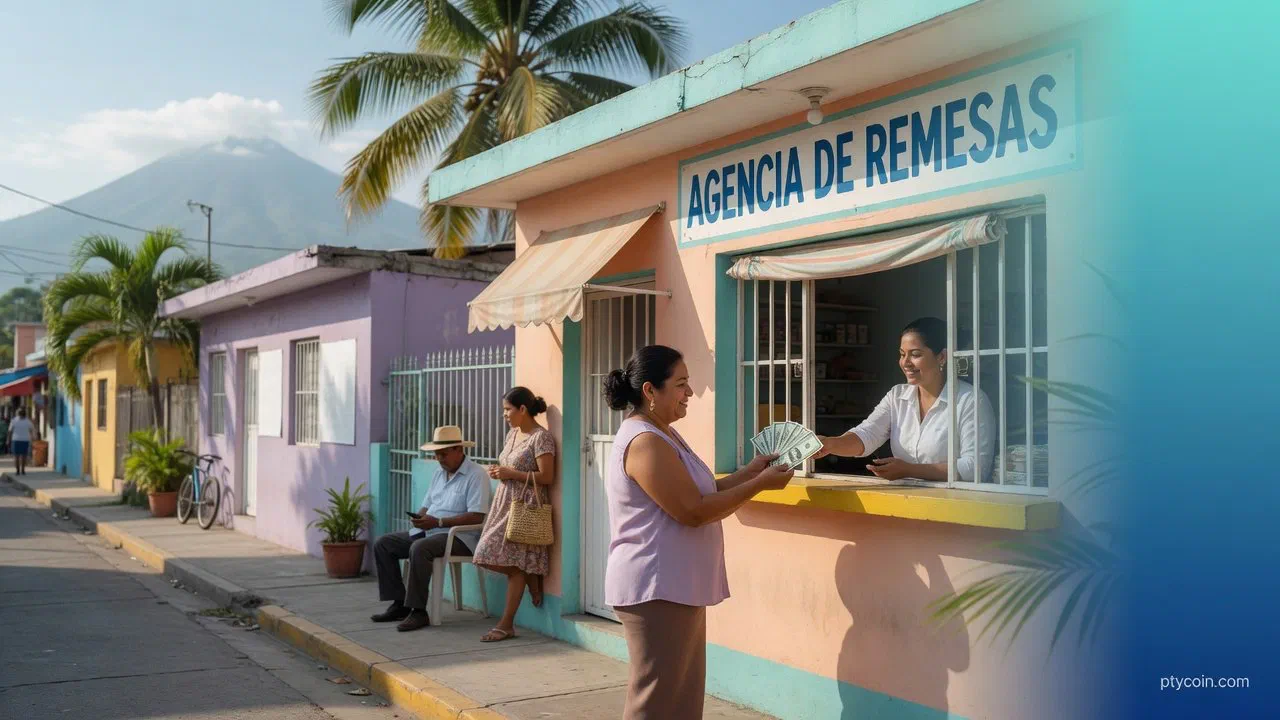
Cash hand-carried home and bank or remesadora transfers still dominate because they match how senders and receivers already behave: pick-up points near home, Spanish-language agents, and a clear fiat endpoint in dollars (El Salvador is a dollarized economy). Crypto rails need a working off-ramp, trust in the wallet app, and a reason to change habit. Legal tender status alone did not force that switch.
Chivo, the IMF track, and the rails that still win
Context for the share figure includes the state’s own wallet story. Chivo was the government-backed app pitched as a mass on-ramp for bitcoin remittances and payments. Under El Salvador’s program with the International Monetary Fund (IMF), the government has been unwinding parts of the public bitcoin payment experiment: mandatory merchant acceptance was rolled back, and the Chivo wallet has been winding down rather than scaling as a national remittance default. That is policy history for a separate deep dive; for this news piece the operational fact is simpler. The state product that was supposed to normalize crypto remittances is no longer the growth engine.
Private rails still matter. Strike, Bitso-adjacent corridors, USDT on low-fee chains, and peer-to-peer dollar stablecoin paths move real money for some diaspora users. The BCR series does not break out which tokens or apps sit inside the crypto remittance line item, so treat $35.4 million as an aggregate of recorded digital-currency channels, not a pure “bitcoin only” print. What the aggregate does show is ceiling: even after a strong percentage gain, crypto remains a rounding error next to Western Union-style volume.
For readers outside El Salvador who watch LatAm payments, the lesson is not that remittances “failed crypto” forever. It is that legal-tender headlines and treasury bitcoin buys can travel the world while household money still prefers the remesadora window. Product, fees, and cash-out matter more than constitutional status for day-to-day sends.
Takeaway
H1 2026 BCR-linked reporting puts El Salvador crypto remittances at $35.4 million, about 0.7% of more than $5 billion in total family remittances, with banks and remittance firms still above 84% of the flow. Crypto volume is up roughly 39% from H1 2025’s $25.4 million, but the share stays under 1% five years after the Bitcoin Law. Growth without share is still progress for the people who already use the rail; it is not the remittance revolution once sold as the law’s everyday win. This is reporting on central bank remittance statistics, not investment advice.