
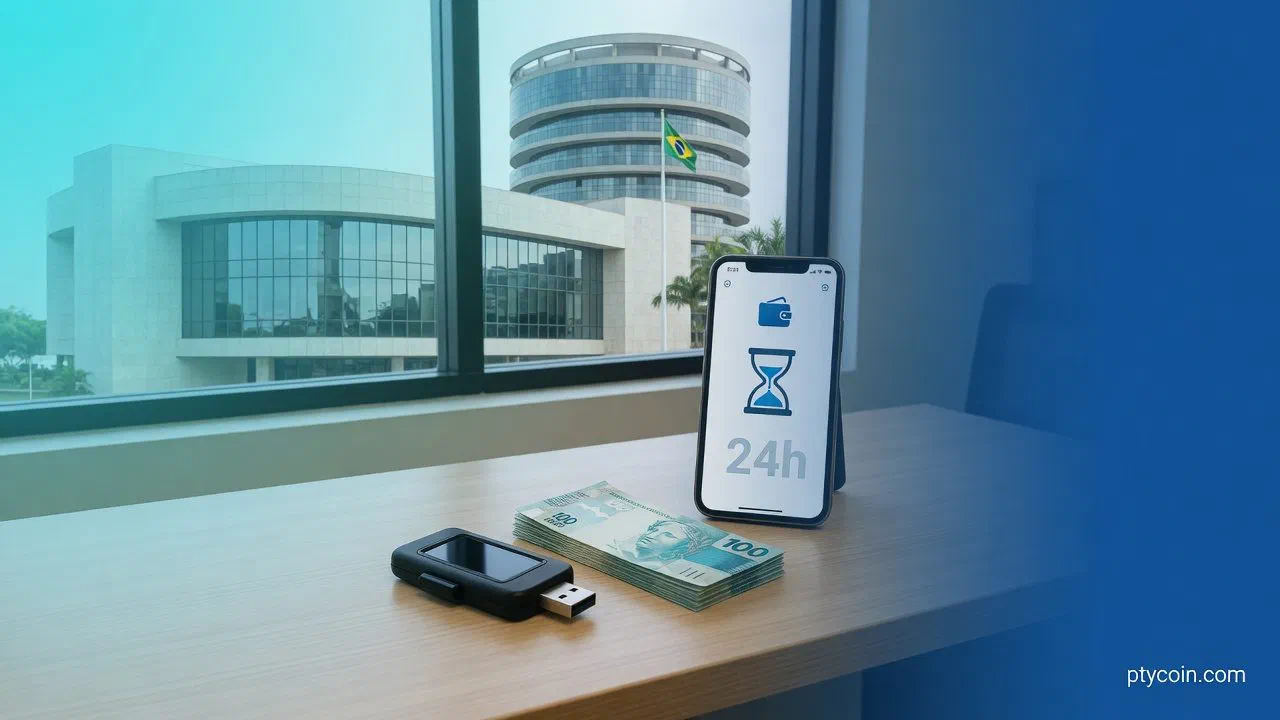
On 7 August 2026 the Banco Central do Brasil (BCB) published Resolução BCB nº 584 (Resolução BCB n° 584, de 7 de agosto de 2026), amending Resolução BCB nº 142 of 23 September 2021, the existing fraud-prevention rulebook for payment services. The new article, art. 2º-B, requires authorized virtual-asset providers to apply a precautionary hold of up to 24 hours on qualifying transfers bound for a self-custody wallet or a foreign virtual-asset firm. The trigger is a transfer above US$10,000, counted as one send or as the client’s total on the same day. The BCB’s 7 August note sets the start date at 1 January 2027.
Status, stated plainly: Resolução 584 is published and sits in the BCB rulebook, with force from 1 January 2027.
From the June proposal to a numbered resolution
PTYcoin covered this measure in early July, when the BCB was still circulating a sector draft and industry comments were due 2 July 2026. That write-up treated the hold as a proposal, with an expected October 2026 start if adopted as circulated. Resolução 584 is the follow-through.
Three things changed between the draft and the numbered text:
- It is now a numbered BCB resolution. The hold sits inside Res. 142/2021 (arts. 1º, 2º-A, 2º-B, 4º and 6º-A, as amended), so it rides the same fraud-prevention machinery already used for PIX and other payment services rather than living as a one-off crypto circular.
- The start date moved. October 2026 became 1 January 2027. Platforms get the rest of 2026 to wire up daily-aggregate counters, hold queues, customer notices, and early-release documentation. That window overlaps the 30 October 2026 SPSAV filing deadline under Resolução BCB nº 520.
- The supervisor’s backup tools are explicit. If a firm mishandles the hold, the BCB can lengthen the review window, apply it below the US$10,000 line, or clip the right to release early.
The legal base is still Lei nº 14.478/2022 (the Virtual Assets Law). The hold applies to the virtual-asset services listed in art. 5º, items I through V of that statute, which includes stablecoins. Firms still adapting under Res. 520 sit inside the same perimeter.
What art. 2º-B actually requires
Secondary analyses of the published text (Unblock Pay, cadoc.ai, Cointelegraph, Blockhead) converge on the same operational test. Confirm any implementation detail against the official resolution.
The hold fires when both of the following are true, or when the firm’s own risk policy says so (§ 1º, III):
| Condition | What counts |
|---|---|
| Destination | A foreign entity that operates in the virtual-asset market, or a self-custody wallet (the private key sits only with the holder; no intermediary) |
| Amount | More than the equivalent of US$10,000, as a single transfer or as the client’s combined transfers that day |
The clock starts when the funding assets (reais or crypto) land in the provider’s wallet, not when the outbound chain transaction is broadcast. Transfers that stay on the same regulated Brazilian platform, or move between accounts at that platform, sit outside art. 2º-B.
Two statutory guardrails matter for anyone who will actually hit the hold:
- It is precautionary. The assets stay the client’s. The rule does not authorize a permanent freeze or a forfeiture (§ 1º, I and II).
- 24 hours is a ceiling. Once the review is done, the provider may release earlier if it records a reasoned decision (§ 5º) and tells the client. The BCB framed the pause as a review window, not a freeze: the transfer still goes through, just not instantly.
Providers must also keep daily records of fraud and attempted fraud in both payment and virtual-asset services, plus the corrective steps they took. Art. 6º-A lets the BCB set what gets filed, and how often.
The risk review itself is the familiar four-axis screen: the client’s profile, the operation, the counterparty, and the destination jurisdiction. Res. 520 already demanded limits, temporary blocks, five-year records, Travel Rule data, and sanctions-list monitoring. Resolução 584 adds a mandatory trigger at a named destination-and-amount pair, so a US$12,000 hardware-wallet withdrawal is held unless the documented review clears it.
Who feels this on 1 January 2027
Users moving size off a Brazilian intermediary. A freelancer who receives a US$12,000 USDC invoice and wants it on a hardware wallet the same afternoon will wait, unless the platform finishes its review sooner. Four US$3,000 withdrawals in one day count the same way: the rule is written on the daily total.
Users staying inside a licensed Brazilian venue. Spot trades, internal book transfers, and withdrawals that remain at the same SPSAV are the flows art. 2º-B leaves alone. The friction is at the exit, which is where recovered-fraud money usually disappears.
Self-custody. Resolução 584 does not outlaw holding your own keys. The BCB is putting a speed bump on the last regulated hop before those keys. Coins already in a wallet you control are outside art. 2º-B. Coins still sitting on a Brazilian exchange, bound for a withdrawal above the line, will get a notice and a documented review.
Platforms and banks. SPSAVs, payment institutions in the Brazilian Payment System, and other BCB-authorized firms have to ship a per-client daily aggregator, a hold queue, notices that call the pause precautionary, and an audit trail for every early release. cadoc.ai’s read lists the systems work: new statuses, a timer, destination classification, and a daily fraud log. Doing that while finishing the Res. 520 file is the 2026 compliance calendar.
Brazil is the region’s deepest crypto market (Chainalysis ranked it fifth globally in 2025, with US$318.8 billion received between July 2024 and June 2025). Stablecoins carry a large share of that value: payroll, remittances, and a dollar hedge that never touches a U.S. bank. When the BCB writes a 24-hour review into the exit to self-custody or to a foreign VASP, corridors that used Brazilian on-ramps as a fast hop will reprice that hop as next-day. Supervisors in Buenos Aires, Mexico City, and Bogotá now have a finished, numbered template they can copy, tighten, or reject. Argentina’s CNV PSAV registry and Mexico’s Banxico/CNBV stack already police the intermediary; they have not, as of this writing, published an equivalent 24-hour exit hold.
What to do with the next five months
If you use a Brazilian platform:
- Test a small withdrawal now, before the rule is live, so you know the venue will actually release coins to an address you control.
- Plan large exits. Amounts above US$10,000 equivalent, or several sends that add up to that in one day, should be treated as next-day from 1 January 2027. Keep a record of source and purpose; that is what the platform’s review will ask for.
- Watch the venue’s SPSAV status as well as its hold policy. A platform that misses the 30 October filing has a wind-down problem that dwarfs a 24-hour pause.
If you build or run a VASP that touches Brazilian clients: treat 1 January 2027 as a production date. The hold logic has to see same-day totals, not only single tickets. Early-release memos have to exist as documents the BCB can request. Customer notices have to say “precautionary” and state the clock. And the Tipo 3 prudential build-out under Resolução BCB nº 580 still starts the same day the hold does.
This is a reading of a published BCB resolution, not legal, tax, or investment advice. Verify the operative wording on the BCB normative page for Resolução 584 before you change a product or a withdrawal plan.
Takeaway
Resolução BCB nº 584 of 7 August 2026 inserts a 24-hour precautionary hold into Res. 142/2021 for virtual-asset transfers above US$10,000 (single or same-day total) sent to self-custody or a foreign provider. It takes effect 1 January 2027. Self-custody stays legal; large exits from a supervised Brazilian intermediary stop being instant by default. Build against the numbered resolution. The calendar now has two hard Brazilian dates five months apart: file the SPSAV request by 30 October, then have the hold queue live on New Year’s Day.