
MoneyGram put MoneyGram Ramps live on Solana on August 11, 2026, giving wallets, exchanges, and app builders a single API into the money-transfer company’s cash network: cash deposits in more than 25 countries, cash withdrawals in more than 170 countries and territories, and Rift as the first Solana wallet to ship the integration.
What went live
In a PR Newswire release and same-day coverage from CoinDesk and the Solana Foundation, MoneyGram said Ramps is now multichain. Developers on Solana can wire cash-to-crypto and crypto-to-cash flows without standing up their own banking stack or agent network.
Ramps is a developer API rather than a retail-app rebrand. Builders get instant API credentials, sandbox access, documentation and SDKs, and a path MoneyGram says skips separate banking integrations. The product is also listed inside the Solana Developer Platform payments module, next to other issuance, payments, and wallet-management APIs the foundation markets to institutions.
MoneyGram’s scale claims, repeated across the release and Solana’s write-up: more than 60 million active customers, nearly 500,000 retail locations, and a digital footprint across more than 200 countries and territories. Those are company figures for the network footprint Ramps sells access to; they are not audited on-chain volume for the Solana lane.
How a user would use it
Once a wallet or app plugs in, the flow is three steps:
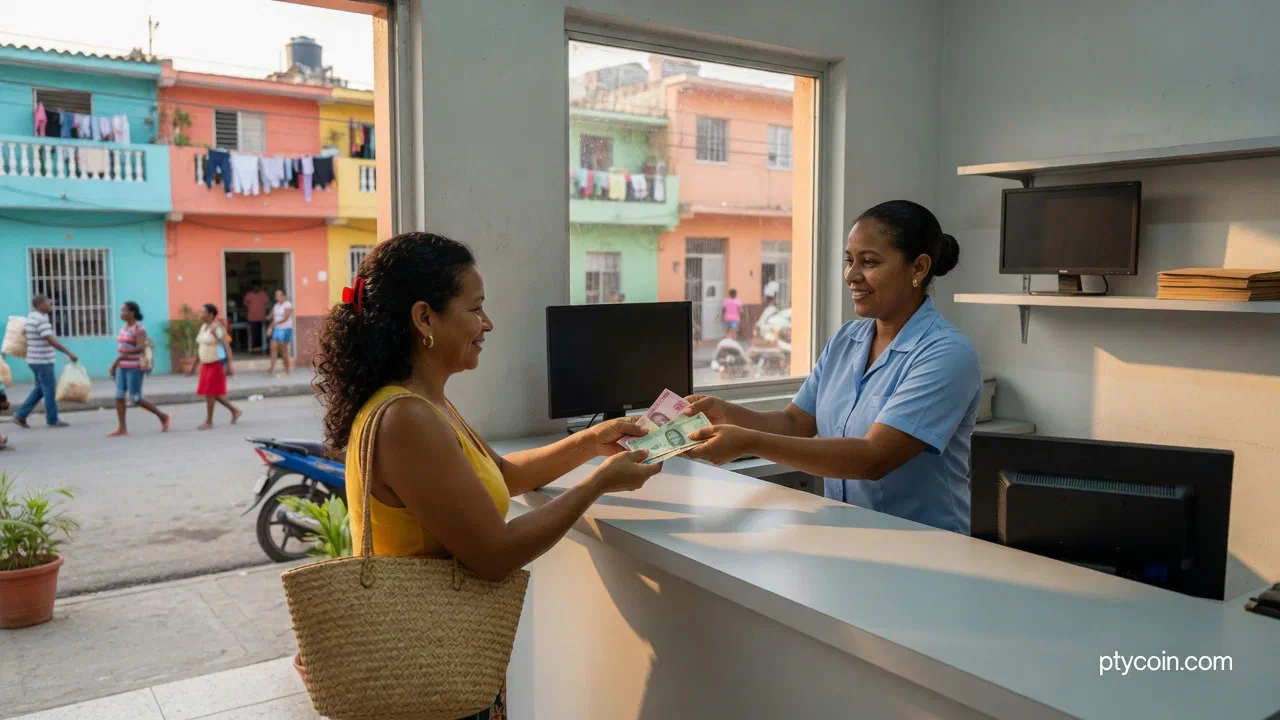
- Cash in. A user walks into a participating MoneyGram location in a deposit-supported market, hands over local currency, and receives digital assets in a supported Solana wallet.
- Cash out. A user holding crypto or stablecoins in a Ramps-enabled wallet initiates a payout and picks up local currency at a participating agent.
- Builder middle. Apps, exchanges, and payroll or remittance products call one API instead of negotiating agent contracts and FX rails country by country.
The Solana Foundation post names three use cases: remittances and cross-border payouts (send on-chain, cash out without a bank account or deep wallet literacy on the receiving end), payroll for distributed and gig workers, and aid distribution into hard-to-reach cash markets. Named stablecoin tickers and fee schedules for the Solana lane are thin in the public materials; prior MoneyGram crypto work has leaned on USDC and, more recently, MoneyGram’s own MGUSD. Confirm the live token list and all-in cost inside each integrated app before treating any corridor as a default.
Rift is the first Solana client
Rift is the first wallet MoneyGram and Solana name as live on Ramps. The press materials describe Rift as an AI-powered, self-custodial trading platform and wallet that already mixes crypto with equities, commodities, and FX-style products. With Ramps, Rift users can move between those digital balances and local cash through MoneyGram’s agent network.
The launch shape is clear: Ramps is meant to show up inside wallets and apps people already use, alongside any MoneyGram-branded crypto destination. More Solana clients are expected; the public launch day named one.
MoneyGram’s longer chain of rails
MoneyGram has been building blockchain exits for years. In 2022, the firm launched a cash on- and off-ramp with the Stellar Development Foundation so users could move between cash and Circle’s USDC through MoneyGram locations. In June 2026, MoneyGram announced MGUSD, a dollar-backed stablecoin issued via Bridge (the Stripe-owned stablecoin infrastructure company) on Stellar, and also joined Solana as a validator. CoinDesk notes MoneyGram among partners in Stripe-led Open USD work as well.
The Solana Ramps launch is the cash-network piece of that strategy: Stellar for earlier USDC and MGUSD rails, Solana for high-throughput wallet and app distribution, and MoneyGram’s agent map as the physical last mile either way. Chairman and CEO Anthony Soohoo cast the launch as network access: every platform connected expands the reach of the cash grid. Solana Foundation President Lily Liu framed it as giving builders fiat connectivity at global scale without reinventing compliance and agent coverage.
Where this sits for LatAm corridors
Latin America is already a dense remittance and cash-out region for MoneyGram and its peers. Readers of this desk saw Western Union’s Stablecard with Rain ship days earlier as a hold-and-spend dollar product for remittance receivers, and El Vecino’s WhatsApp stablecoin lane into Mexico as a corridor-specific send path with SPEI and OXXO exits. MoneyGram Ramps is a third cut of the same job: cash in and cash out at agent scale, exposed as an API to any Solana wallet or app that integrates it.
For senders and freelancers who already hold USDC or other dollar tokens on Solana, an agent cash-out in a MoneyGram-served town is the boring last mile that makes on-chain balances useful when the recipient still wants pesos, reais, or quetzales in hand. For families who never open a seed-phrase wallet, the surface that matters is whatever app or local partner embeds Ramps. Country-level deposit and withdrawal lists, fee cards, and KYC rules will decide whether a given corridor competes with a traditional MoneyGram transfer or a Bitso/Belo-style local stablecoin product.
The launch package still lacks a published LatAm country matrix for the Solana lane, independent first-week volume, and a public all-in cost comparison versus a classic agent remittance for a $200 or $500 send. Those numbers will separate a real rail from a developer-platform press cycle.
What to watch
Three checkpoints will show whether Solana Ramps is product infrastructure or a partnership headline:
- Client count. How many Solana wallets and remittance apps beyond Rift ship a live cash-in/cash-out button in the next quarter.
- Corridor clarity. Named deposit and withdrawal countries in Mexico, Brazil, Colombia, Central America, and the Caribbean, with fee and limit cards a user can actually read.
- Token and custody path. Which assets settle (USDC, MGUSD, others), whether balances stay in the user’s wallet through cash-out, and how compliance freezes interact with self-custody claims in each integrated app.
Takeaway
On August 11, MoneyGram made Ramps available on Solana: one API into cash deposits in 25+ countries and cash withdrawals in 170+, with Rift as the first live wallet client and the product embedded in the Solana Developer Platform. The company is selling the same thing it has always sold (physical cash access at global agent density), now as multichain developer plumbing next to its Stellar USDC history, MGUSD issue, and Solana validator seat.
For readers who already move dollars on-chain, this is another named path from a Solana balance to a neighborhood cash counter. For readers who only ever pick up remittances at an agent window, it may show up later as a button inside an app they already trust. Check availability, fees, and supported assets in the specific wallet before you plan rent money around a new rail. This is product reporting, not a recommendation to change how you send or receive.