
Yes. Practice a seed phrase restore before your savings depend on it. Writing twelve or twenty-four words is half the job. The other half is proving those words open the same wallet on another device.
This guide is the full dry-run. It builds on what a seed phrase is and self-custody without a single point of failure. Those explain the backup. This one walks the restore drill itself.
Not financial advice. Enter recovery words only on hardware you trust, never on a website or “support” chat. Practice with a spare device or a throwaway test wallet first. Vendor menus change; re-check the official docs for your model before you wipe anything that holds real value.
Why an untested backup is still a guess
A BIP-39 seed phrase is the master secret for every key your wallet derives. One wrong word, one swapped position, or one forgotten passphrase, and the restore opens a different empty wallet. Your coins stay on the old addresses. You just cannot reach them.
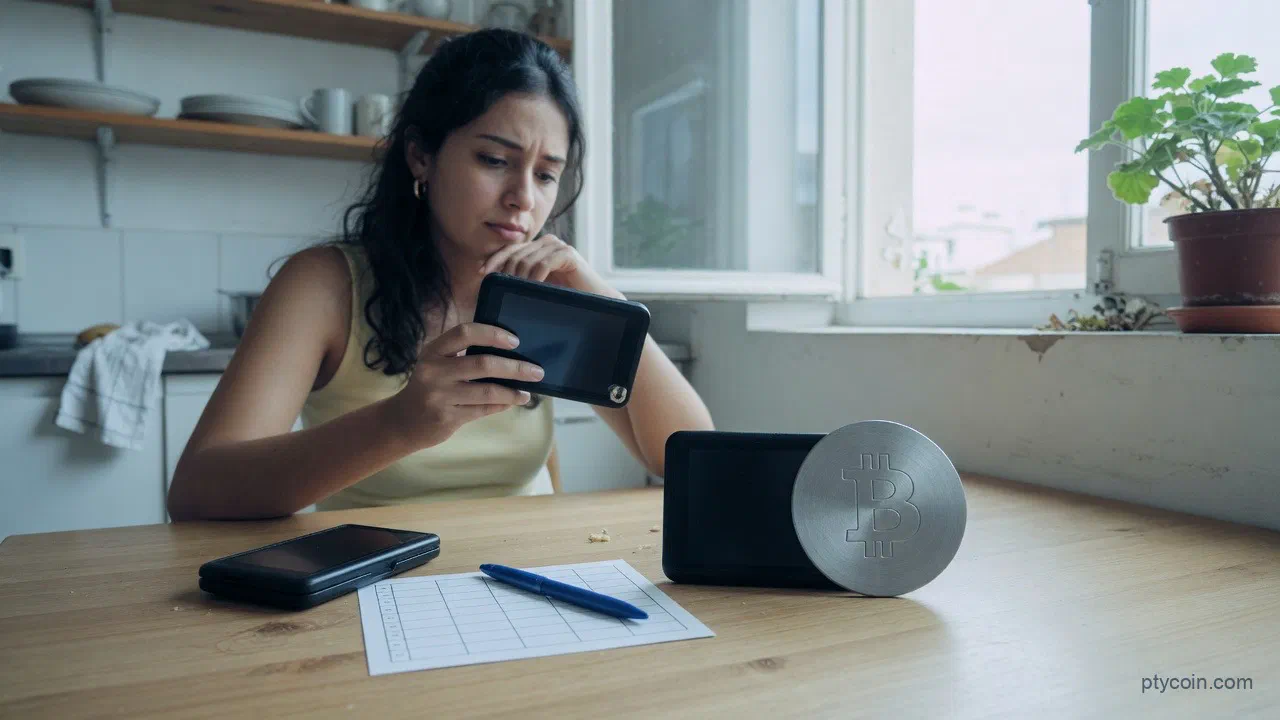
Paper fades. Metal stamps go wrong. Humidity and rainy seasons across Latin America ruin ink faster than people expect. The failure shows up on the worst day: a broken device, a theft, a move, a flood. Do the drill while you are calm and the original device still works.
Three checks. Stop if any step fails while the original wallet still works.
Safety rules before you touch a word
- Never type a funded seed into a website, browser “recovery” form, email, WhatsApp, or cloud note. Real vendor support will not ask for your words. Fake ones will. Pair this with how to spot phishing and fake wallet apps.
- Prefer on-device entry when your hardware wallet supports Recovery Check or Check backup.
- Do not wipe your only working device until a spare restore has already shown the same addresses.
- If you use a BIP-39 passphrase (the optional “25th word”), practice with that passphrase too. The plain seed alone opens a different wallet, usually empty.
- Buy spare hardware from the official manufacturer or an authorized seller. A pre-initialized second-hand device is an attack. See hardware wallet form factors if you still need to choose.
Path A: verify the backup without wiping (do this first)
Most modern hardware wallets can check your written words against the seed already on the device. Nothing is erased. Start here.
Ledger: Recovery Check
Ledger’s Recovery Check app confirms spelling and order on the device.
- Open Ledger Wallet (the app formerly called Ledger Live) and connect the device with your normal primary PIN.
- Install Recovery Check from My Ledger / Manager. Uninstall unused apps temporarily if the device needs space. Your coins live on the blockchain, not in those apps.
- Open Recovery Check on the Ledger itself.
- Choose the word count (12, 18, or 24).
- Enter each word on the device buttons or touchscreen. Select the suggested BIP-39 word only when it matches what you wrote.
- Success means the phrase matches what the device stores. Failure means fix the paper (or move funds) before you wipe anything.
- Uninstall Recovery Check when you are done.
Recovery Check does not verify a passphrase. Unlock with the primary PIN. If you rely on a passphrase, Path B below is mandatory. If the check fails and you still control the device, follow Ledger’s failed recovery check guidance: move funds out, reset, create a new seed, verify it, then move funds back.
Trezor: Check backup
Trezor Suite calls this Check backup (historically “dry-run recovery”). Model guides live under Trezor backups and recovery.
- Open Trezor Suite (desktop preferred). Connect and unlock the device.
- Open Device settings → Wallet backup → Check backup.
- Confirm you understand, then start.
- Enter each word on the device as prompted (touchscreen models) or follow the Model One matrix / standard flow the device shows.
- Success means the written backup matches. Failure means do not wipe. Re-check spelling and order, then move funds if it still fails.
Do this after setup, before firmware updates, and on a regular calendar. Twice a year is a solid habit.
Coldcard: quiz, temporary seed, or spare restore
Coldcard quizzes you on words during initial backup. For an ongoing drill, Coinkite’s rule is blunt: backup first, then prove recovery. Prefer a second Coldcard or a temporary-seed path over destroying your only master seed. See master seed import and encrypted backups for your model’s menus. After restore, compare the wallet fingerprint and receive addresses before you trust it.
Path B: full restore on a spare or wiped test device
This is the emergency rehearsal. Use it after Path A passes, or when your vendor has no check feature.
- Prepare a spare device that holds nothing you care about, or factory-reset a practice unit.
- Work from your paper or metal copy, not from memory.
- Start Recover / Restore existing wallet on the spare. Do not create a new wallet.
- Enter the words in exact order. Match BIP-39 spelling. The last word is a checksum; many devices reject a bad list here.
- Enter the passphrase if you use one. Wrong passphrase = wrong empty wallet.
- Open the companion app (Ledger Wallet, Trezor Suite, Sparrow, Electrum) and add the same accounts you use day to day.
- Compare receive addresses to a short list you saved earlier from the original device. Match character by character.
- Optional: send a tiny test amount to one restored address, confirm it arrives, then send it back out.
- Wipe the spare when the drill is over, unless you deliberately keep it as a warm spare.
Official restore docs: Ledger restore from recovery phrase, Trezor recover wallet, Coldcard import existing / master seed.
Path C: software-wallet practice with a throwaway seed
Use this only to learn the typing flow. Do not import a hardware wallet’s funded seed into MetaMask or any hot wallet. That defeats the hardware.
- On a clean browser profile, create a new MetaMask wallet with no real funds.
- Write that throwaway Secret Recovery Phrase on paper.
- Reset or reinstall MetaMask.
- Choose Import using Secret Recovery Phrase and follow MetaMask’s official restore steps.
- Confirm the accounts reappear, then destroy the throwaway paper.
If MetaMask holds only small spending balances, you may practice restoring that seed the same way on a device you control. Still never type it into any site that is not the official extension or app you installed yourself.
How do you know the restore worked?
Three signals. Prefer all three for anything that matters.
| Check | Pass means | Fail means |
|---|---|---|
| Vendor check / Recovery Check | Written words match the device seed | Fix the backup before wiping anything |
| Receive address match | Restored wallet shows the same addresses you recorded earlier | Wrong words, order, passphrase, or derivation path |
| Tiny test send | Coins arrive on the restored address | Stop. Do not wipe the original device |
Save a few receive addresses offline (on paper, not in the same envelope as the seed) before you ever need them. Address match is the fastest honest test.
What usually goes wrong
- Wrong word order. Swapping two words fails the checksum or opens empty addresses.
- Lookalike words.
sword/sworn,cash/case. Read letter by letter. - Missing passphrase. The plain seed restores an empty decoy wallet.
- Wrong derivation path or account. Some software wallets need accounts or networks re-added after restore, so the UI can look empty even when the seed is right.
- Practicing on a phishing clone. Download Ledger Wallet, Trezor Suite, and MetaMask only from official domains.
If the drill fails and the original device still unlocks, move funds to a new wallet with a freshly verified backup. Do not hope the bad paper will work later.
After the drill
- Confirm every physical copy matches the words you just proved.
- Store copies in separate places so one fire or flood cannot erase every copy.
- Prefer metal where humidity or long storage are real risks. Paper is short-term.
- Label nothing “crypto” or “seed.”
- Set a calendar reminder: verify twice a year, and after any move or family handoff.
If someone else may need access when you cannot help, walk them through Path A on a spare with a test seed first. Do not leave twelve unexplained words in a drawer.
Takeaway
A seed phrase you have never restored is a hope, not a backup. Verify on-device when your vendor supports it. Then restore on a spare, confirm the addresses, and wipe the spare. Do that while life is quiet.
Start with Path A this week. Run the spare-device restore before the next large transfer off an exchange. Keep the paper or metal honest, and keep the words off the internet.