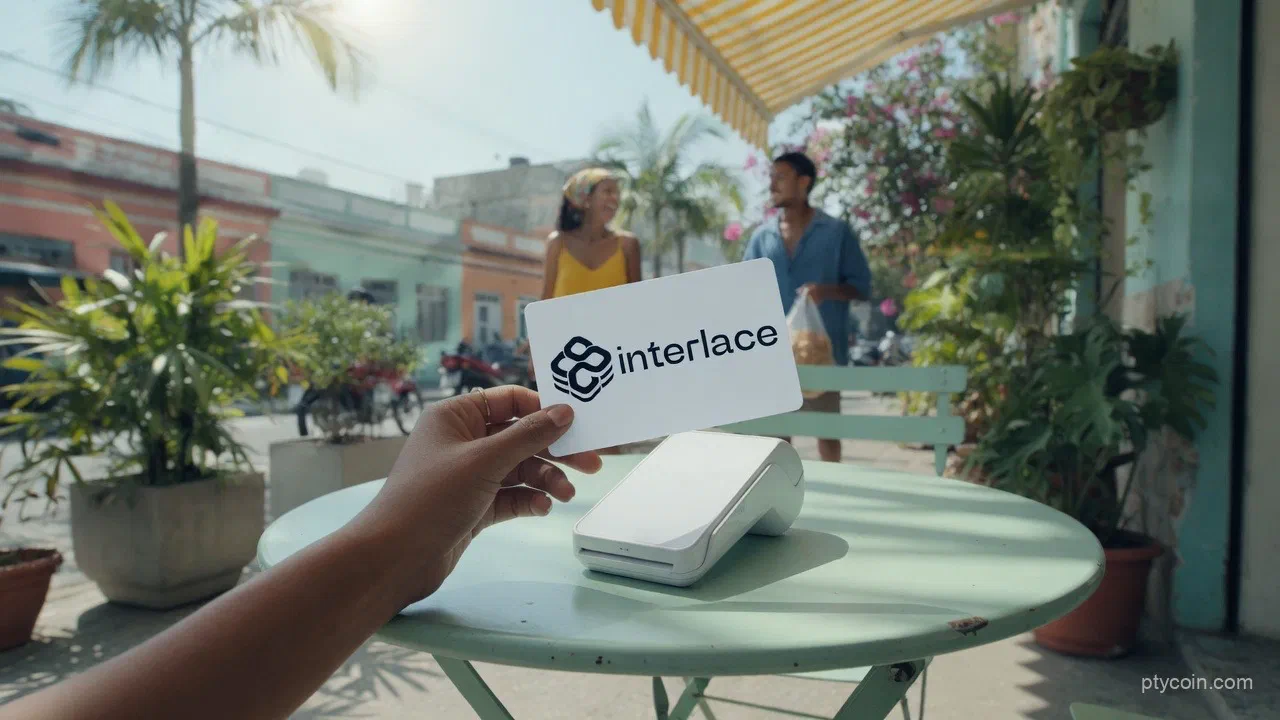
Interlace opened a Brazil office and named Guilherme Santos country manager on 18 August 2026, planting a local team in one of Latin America’s densest stablecoin markets so the Singapore-founded payments firm can sell card issuing, on/off-ramps, and multi-currency accounts to Brazilian institutions and Web3 builders.
What Interlace announced
In an 18 August X post and same-week coverage from crypto.news and BYDFi, the company framed the move as “Going global. Building local.” The Brazil operation is meant to connect local financial institutions, cross-border trade platforms, digital-asset companies, and Web3 projects to Interlace’s existing global stack.
Santos already showed up on the Brazil circuit. The firm attended Blockchain.RIO in Rio de Janeiro, where he sat on a panel about digital assets, stablecoin payments, and financial infrastructure. The next stop on the calendar was the LATAM Digital Assets Conference hosted by Crecimiento in Buenos Aires on 20–21 August 2026, where Interlace said it would present global card-issuance practice and its LatAm plans.
What the announcement does not include: named Brazilian banking partners, a Pix integration launch, fee cards, corridor lists, or a local VASP or payment-institution license number. Treat the office as a commercial foothold until those product details ship.
What the company actually sells
Interlace’s site and Our Story page describe a business-facing stack rather than a retail wallet:
- Card issuing (CaaS): branded physical and virtual cards across 30+ BINs and 180+ countries; the company claims 7 million+ cards issued for 12,000+ businesses.
- CryptoConnect: crypto wallets with fiat↔crypto on/off-ramps and transfers.
- Banking-as-a-Service and multi-currency business accounts: assemble banking components and hold balances such as USD, EUR, GBP, and HKD under a business name.
- Scale claims on the marketing site: $15 billion+ in processed transactions and triple-digit percentage growth in stablecoin processing volume. Those are company figures, not an audited Brazil volume print.
Founded in 2019, Interlace says it holds a Hong Kong TCSP license, a U.S. FinCEN MSB, a Canadian FINTRAC MSB, and PCI DSS Level 1. In December 2024 it closed a $10 million Series B1 led by Bitrock Capital, per a PR Newswire release. The Brazil office is the LatAm cut of that expansion story, not a new product category by itself.
Why Brazil is the market that fits the product
Brazil already runs on instant domestic rails and dollar-token demand at the same time. Pix processes enormous local volume; crypto.news repeats the familiar 2024 footprint of nearly 170 million Pix users and about BRL 11 trillion in annual transactions. On the crypto side, Banco Central do Brasil Governor Gabriel Galípolo has said stablecoins make up about 90% of Brazil’s reported crypto flows, and the bank’s own H1 2026 books put resident crypto purchases at $14.68 billion, with stablecoins dominating identified demand (our H1 write-up).
That combination is exactly what a card-plus-ramp vendor wants: local fiat that moves in seconds, and dollar stablecoins that settle cross-border outside banking hours. It is also why regulators are watching. Resolution BCB nº 561 keeps virtual assets out of settlement inside certain regulated electronic foreign-exchange channels, without banning crypto trading or stablecoin transfers elsewhere. The IMF has separately pushed for tighter rules on customer-asset protection, issuance, and AML as Brazil’s crypto flows outpaced traditional capital movements. An office that wants bank and fintech partners has to clear that compliance lane, not just open a coworking desk.
How this sits next to other rails we cover
Readers of this desk already saw several cuts of the same job in August alone: MoneyGram Ramps on Solana as cash-in/cash-out API plumbing, Western Union’s Stablecard as a hold-and-spend dollar product, El Vecino’s WhatsApp lane into Mexico as a corridor-specific send path, and Koywe’s Pix/SPEI/PSE API as a LatAm-native on/off-ramp for businesses. Interlace is closer to the card program + global account + ramp bundle sold to platforms than to a consumer remittance app.
For a Brazilian fintech, exchange, or marketplace, the pitch is one vendor for branded cards, multi-currency balances, and stablecoin settlement. For a self-custody user who only holds keys in a personal wallet, Interlace is upstream infrastructure you may never see by name; it shows up later as a card or cash-out button inside someone else’s product.
What to watch next
Three checkpoints separate an office opening from a live Brazil rail:
- Local partners and methods. Named banks, Pix collectors, or payment institutions, plus which Interlace products those partners actually ship.
- Licensing surface. Which Brazilian entity sits under each service, and whether any VASP or payment-institution registration is published.
- Corridors and costs. Public fee cards, supported assets, and whether Brazil is a pay-in market, a card-spend market, a B2B settlement market, or all three.
Takeaway
On 18 August 2026, Interlace put a Brazil office and country manager Guilherme Santos on the map, then carried the same pitch from Blockchain.RIO into Buenos Aires’ LATAM Digital Assets Conference. The company is selling stablecoin-linked cards, accounts, and ramps into a market where Pix already owns domestic speed and dollar tokens already dominate reported crypto demand.
Until partners, licenses, and fee cards appear, this is a commercial landing, not a finished Brazilian product sheet. If you build or buy payment infrastructure in Brazil, ask which local entity, which Pix or bank partner, and which all-in cost sit behind the new office before you treat it as a live rail. This is product reporting, not a recommendation to integrate or hold any token.