

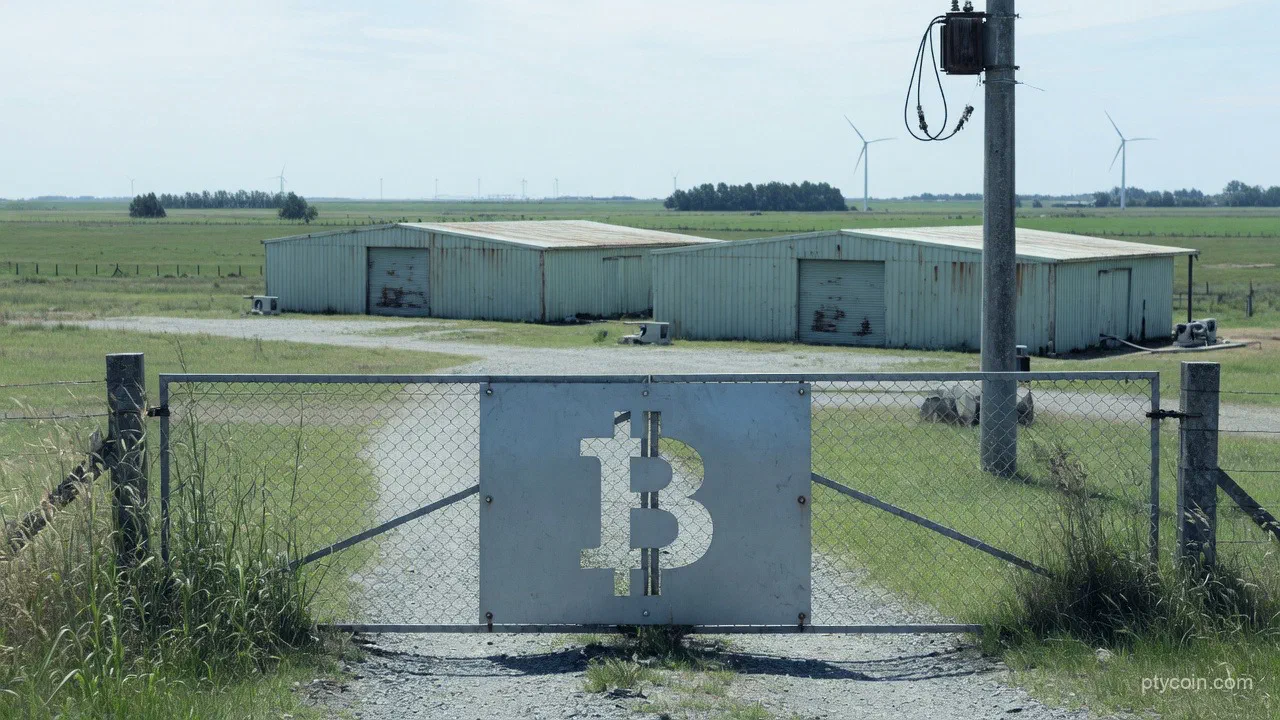
Tether abandoned two Bitcoin mining sites in Uruguay after state utility UTE cut power in July 2025, a Reuters investigation published 21 August 2026 reconstructs from documents and interviews. A former contractor put spending at roughly $60 million per site, about $120 million across the Florida-department facilities run through local unit Microfin. Tether and Microfin did not comment to Reuters.
What Tether promised in Uruguay
In May 2023, Tether publicly pitched Uruguay as the “perfect platform” for renewable-powered Bitcoin mining: a stable grid, abundant wind and hydro, political calm, and a tax setup it liked. The plan was a South American springboard before bigger pushes into Brazil, Paraguay, and Argentina.
Two sites went up in the Florida department, near farmland and wind turbines. A February 2024 company video showed mining halls with crypto-themed road names such as “Memepool Avenue” and “Halving Street.” Local coverage from El Observador earlier described a wider ambition of up to $500 million, including a third processing center and a large wind-and-solar park that never arrived. What actually got built and powered was the Florida pair.
How the UTE contract broke
The core fight was over how much electricity the contract allowed. Per Reuters, Microfin treated a contracted figure as a minimum that could grow with demand; UTE treated it as a hard maximum. An internal UTE briefing reviewed by the reporters shows the sides were already stuck by November 2024. As the sites drew more load, they sometimes sat short of power for days.
Politics hardened the standoff. A left-leaning government took office in March 2025 and installed new UTE directors who took a firmer line on renegotiation. Around May 2025, Microfin stopped paying electricity bills. In June, it told UTE it would terminate the contracts. A last salvage package (revised paperwork plus a memorandum of understanding that UTE’s board had approved) collapsed when Tether representatives did not attend the signing, Reuters reports.
UTE cut power to both sites on 25 July 2025. Microfin later settled outstanding debts in December. On 25 November 2025, Tether notified Uruguay’s labor authorities it would cease operations and lay off most staff (local reporting put the cut at about 30 of 38 workers), which El Observador covered at the time. Secondary write-ups such as Cryptopolitan largely track the Reuters timeline.
Why this lands differently than Adecoagro in Brazil
Mining is hypermobile: racks move, and a country can lose the load overnight when the power math fails. Uruguay’s grid is clean and reliable, but its industrial tariffs are not the rock-bottom rates large miners chase after the April 2024 halving and weaker coin prices. Reuters quotes experts who say the same renewable footprint may suit AI or high-performance computing better than ASIC farms that live or die on cents per kilowatt-hour.
That contrast matters next door. In the same month UTE cut Microfin’s power, Tether deepened a Brazil path with agribusiness Adecoagro: a bagasse-powered pilot in Mato Grosso do Sul that we tracked from announcement through the July 1 start. Colocating miners on surplus mill electricity is a different bet from buying grid power from a state monopoly under a disputed cap. USDT still dominates everyday dollar-token use across Latin America for remittances, savings, and settlement; the Uruguay exit is about physical hashrate economics, not about the stablecoin leaving the region’s wallets.
For Uruguay, the episode is a caution for any large flexible load that needs a predictable, scalable tariff, not only crypto. For Brazil and other neighbors courting miners, it is a reminder that “renewable” and “cheap enough for ASICs” are separate claims.
Takeaway
Reuters’ 21 August 2026 reconstruction closes the book on Tether’s Uruguay mining chapter: two Florida sites, a Microfin–UTE fight over min-versus-max power, a July 2025 cutoff, staff layoffs, and roughly $120 million in sunk build-out with little lasting local footprint. The company’s regional mining story did not end; it shifted toward projects that own or sit on surplus generation, starting with Adecoagro’s sugarcane pilot.
If you follow Tether’s physical bets in Latin America, treat Uruguay as the failed grid-purchase template and Brazil’s mill-colocated model as the live one until the next public milestone. This is reporting on infrastructure outcomes, not advice to buy, sell, or mine any asset.