
Register a llave before you treat any crypto cash-out as instant. Banco de la República’s explainer lists four personal key types: your identity document, your mobile number, your email, and an alphanumeric code your bank or wallet generates. One llave maps to one account. One account can hold several llaves. You can send without a llave. You cannot receive without one. The 2026 per-transfer ceiling is 1,000 Unidades de Valor Básico, which BanRep publishes as COP 12,110,000; your entity can set less.
This is the Colombia counterpart to USDT with Pix in Brazil and stablecoins and SPEI in Mexico. Use it with the network guide, gas planning, and self-custody 101.
Not financial advice. Bank apps, exchange menus, fees, GMF (4×1.000), and tax rules change. Practice with a small amount first. Confirm the network before anyone sends. This is education, not a recommendation of any venue.
What is Bre-B?
Bre-B is Colombia’s interoperable instant payment system. Banco de la República built it so existing private networks could talk to each other. BanRep’s March 2026 history dates full operation to 6 October 2025.
It is not an app. Do not download anything named Bre-B. Open the bank or wallet you already use and look for Zona Bre-B after login. BanRep’s security notes say registration has no fee, happens only in those official channels, and never through a link in SMS, WhatsApp, or email.
Pesos move in about 20 seconds, 24 hours a day. Person-to-person and person-to-merchant payments are in scope. QR codes exist too. BanRep’s amount FAQ is the source for the 1,000 UVB cap. A llave is Colombia’s alias, like a chave Pix. Mexico’s default SPEI identifier is still an 18-digit CLABE.
How do you register a llave?
- Open your bank or wallet app. Nequi, Daviplata, Bancolombia, Lulo, and many cooperatives sit on BanRep’s participant list (updated 27 July 2026).
- Find Zona Bre-B on the first screens after login.
- Choose a key type you control: cédula, phone, email, or the alphanumeric code the entity offers.
- Confirm the account it will credit. A llave sits on only one account at a time. If you later move a phone-number llave, inbound pesos follow the new account.
The llave is not your login. If a stranger asks you to “validate” it by sending money, stop.
Bre-B versus PSE versus Transfiya
Colombian crypto deposits still show different peso labels. Mixing them up is how an “instant” cash-out turns into a next-day wait.
| Label on the screen | What it actually is | Typical crypto use |
|---|---|---|
| Bre-B | BanRep instant rail, addressed by llave or QR | Instant COP in/out when the venue has wired it |
| PSE (Pagos Seguros en Línea) | Merchant debit button: pick your bank, log into the bank portal, authorize | Still the default COP deposit on several local exchanges |
| ACH / bank transfer | Ordinary interbank credit, often next-day | Fallback when Bre-B is missing |
Transfiya is one of the private instant systems that now interoperates through Bre-B. Your app usually shows Zona Bre-B, not the old brand.
Bitso’s Colombia COP docs still describe PSE as the funding method. Bitso’s cash-out guide (updated 24 July 2026) walks a PSE deposit and a bank-transfer withdrawal with weekday cut-offs. That path works. It is not Bre-B.
Binance documents the other path. Its COP deposit FAQ (updated March 2026) names Bank Transfer (Bre-B). The app generates a destination llave. You pay the exact amount from Zona Bre-B. The key lasts one hour. The withdraw FAQ lists Bre-B as instant and ACH as 1–4 business days. Forbes Colombia reported that integration in February 2026.
Open Deposit → COP and read the method label. If it says Bre-B, you paste a llave. If it says PSE, you log into a bank portal. Do not assume the rail from a headline.
How do you buy USDT or USDC with pesos?
The peso hop and the dollar hop are separate. Bre-B only does the first.
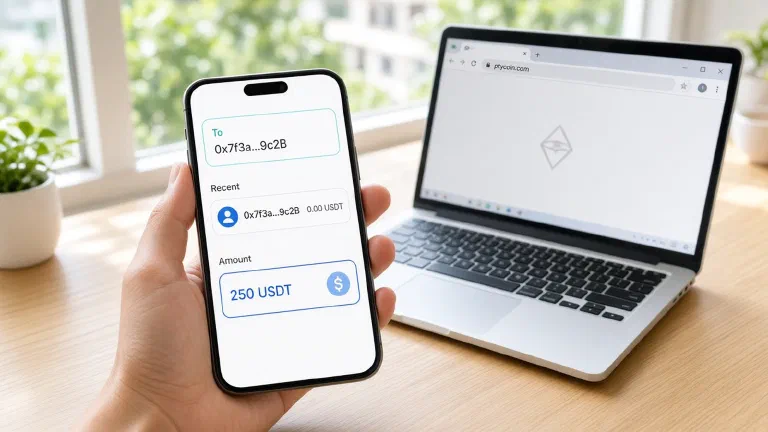
Figure: Bre-B (or PSE) only moves pesos. The token still has to leave the venue on a named network.
Path A: the venue lists Bank Transfer (Bre-B)
- Verify the account with the same cédula your bank knows. Turn on two-factor authentication first.
- Open Deposit → COP → Bank Transfer (Bre-B) (wording varies). Enter the amount.
- Copy the generated llave. It is the venue’s collection key for this order, not your receive llave.
- In your bank app, open Zona Bre-B. Pay exactly that amount before the key expires.
- When COP credits, buy USDT or USDC.
- Withdraw the token to your wallet on a network that wallet supports. Follow the send-safely checklist. Test a tiny amount first.
Path B: the venue still uses PSE
- Same KYC and 2FA.
- Open Deposit → COP → PSE. Enter the amount (Bitso’s public floor is COP 10,000).
- Pick your bank. Finish authorization on the bank’s own site, not a page that arrived by chat.
- Wait for credit. Bitso’s API docs say at most 60 minutes; the consumer blog still allows up to 24 hours. Trust the in-app estimate.
- Buy, then withdraw on-chain as in Path A.
Third-party PSE “because my limit is full” is the same scam pattern as third-party Pix. Pay from an account in your name.
How do you cash out USDT back to a llave?
Reverse the path when you need pesos.
- Send USDT or USDC to the venue deposit address for the same network shown on screen. Confirm on a block explorer before you scale. Wrong-network deposits are often unrecoverable. See the network guide and receiving safely.
- Sell for COP.
- Open Withdraw → COP. If Bre-B is listed, enter your llave and confirm. BanRep’s rail is seconds; the venue still has to release the payment.
- If only ACH or “bank transfer” is listed, expect business-day windows. Bitso’s Colombia blog still quotes 24 or 48 hours depending on the weekday cut-off.
- Check the destination app. Save the venue’s reference. Do not send a second withdrawal until you know where the first one went.
If the payment is large, receive on-chain to your wallet first, then deposit only what you need to sell. Keep a little native gas (TRX, ETH, SOL) so that deposit can leave later. See gas planning.
P2P through Nequi and Daviplata
Nequi and Daviplata are Bre-B participants. A P2P seller who asks for a Nequi send is often moving pesos on the same instant rail, just without an order book. Escrow on the crypto side protects you only if you stay inside the official order and release after the platform confirms the peso payment.
It also concentrates newcomer fraud: a friend’s Nequi “because the limit is full,” a name that does not match the ad, pressure to release USDT early, or a “support” chat that wants your seed phrase. Stay in the official chat. Verify the recipient name. Never share recovery words. See spotting phishing.
Some dollar-account apps have wired Bre-B as an inbound peso path. We covered Littio doing that. Read the receipt. It is not a substitute for a wallet you control.
Where transfers fail
| Failure | What usually happened | What to do |
|---|---|---|
| Generated Bre-B key rejected | You sent the wrong amount, or the one-hour window closed | Do not retry blind. Check the order status. Open a new deposit if the old key is dead |
| PSE authorized, COP never credits | Bank portal glitch, name mismatch, or venue delay | Keep the bank receipt. Wait the in-app estimate before sending again |
| USDT never arrives at the venue | Wrong network or stale deposit address | Stop. Look up the txid. Do not resend |
| Bre-B payout pending for hours | Venue queue, fraud hold, or destination llave moved | Check both apps. Confirm the llave still points at your account |
| Pesos land in someone else’s wallet | You typed a third-party llave | Treat as gone unless they return it. First runs go only to accounts you control |
| 4×1.000 larger than you expected | GMF still applies to many peso hops | Ask your bank how it treats Bre-B on your account type before you size up |
Tax and reporting, lightly
Colombia’s 4×1.000 (gravamen a los movimientos financieros) can still hit the peso hop even when Bre-B itself has no extra fee. BanRep does not waive GMF. Your bank’s account type decides any exemption.
DIAN Resolución 000240 of 24 December 2025 puts provider reporting on tax year 2026, first filing due by the last business day of May 2027. That is the venue’s duty, not a monthly self-filing of the Brazilian DeCripto type. You still declare your own situation. Keep statements. This guide does not replace an accountant.
Takeaway
Bre-B is the peso rail: a llave inside an app you already have, seconds to settle, a 2026 cap of COP 12,110,000. USDT and USDC sit on top. They connect only when the deposit screen names Bre-B. Many Colombian venues still fund through PSE. Read the method label. Pay from your own name. Withdraw the token to a wallet you control. Practice once with an amount you can shrug off.
Brazil and Mexico twins: Pix and SPEI. After the coins arrive, self-custody 101.