
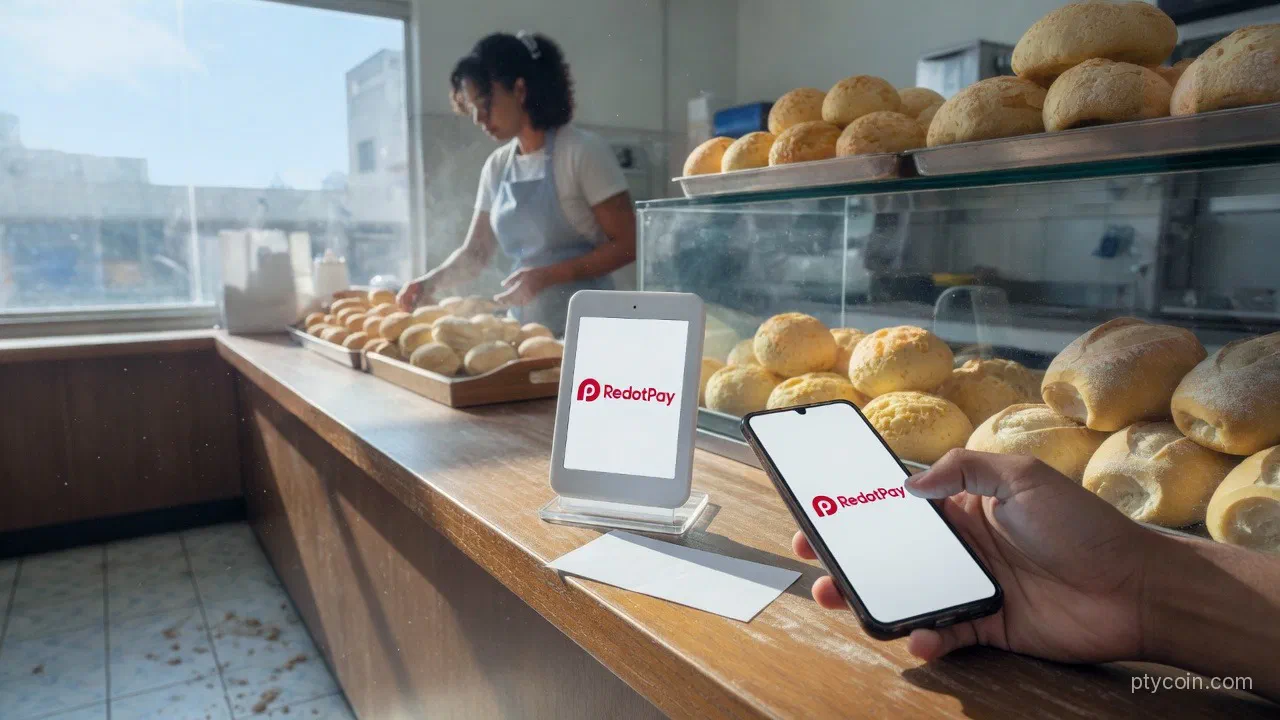
RedotPay said on 8 September 2026 that users can now scan to pay at local merchants in Brazil, Colombia, and Peru, settling from crypto balances inside its app. The company frames the cut as Instant QR payments for everyday spend, not another card swipe.
Its Brazilian and Spanish regional accounts repeated the same three-country list the same day. Treat the corridor list as RedotPay’s claim until a fee card and named rail list land in writing.
What the product page actually promises
RedotPay’s Scan to Pay page describes Instant QR as paying for coffee, taxis, and groceries by scanning a merchant code, with “no pre-conversions needed” on the user side. It says the feature works with local QR systems used by banks and e-wallets, settles in seconds with stablecoins, and shows the exchange rate and any fees before you confirm.
That is the public product claim. The 8 September posts name the three South American markets; they do not publish a named list of which national standards are wired in each country (for example Pix in Brazil, Bre-B in Colombia, or Peru’s interoperable wallet QR). Until RedotPay prints those names, report the countries and the “local QR network” language, not a specific rail you cannot verify from the announcement.
The flow, per the product page and RedotPay’s earlier QR how-to, is familiar: open the app, tap scan, point at a supported merchant code, review the amount and rate, confirm. The April 2026 launch post first shipped Instant QR against VietQR in Vietnam and QRPh in the Philippines. South America is an expansion of that pattern, not a brand-new product category.
Why local QR is the spend surface that matters
In Brazil, Colombia, and Peru, the checkout most people already trust is a QR on a counter, not a crypto ticker. Brazil’s Pix turned account-to-account transfers and merchant payments into everyday habit. Colombia’s Bre-B is the interoperable instant network banks and wallets plug into. Peru’s unified Yape / Plin QR covers a huge share of in-person digital-wallet spend. Those rails are the distribution; stablecoins are the balance that funds the scan.
RedotPay already sells a Visa crypto card accepted at a claimed 130 million-plus merchants, plus P2P and fiat payouts that include BRL and other LatAm currencies. Instant QR is the offline, merchant-QR cut of the same pitch: keep a dollar-linked balance in the app and spend it where locals already point their cameras. Competitors are racing the same corridor. KuCoin Pay ran a September Scan & Pay fest for Brazil, Argentina, and Peru. Bybit Pay said on the same day it connected to Bre-B QR in Colombia. The news is not that one firm invented QR spend; it is that another named app is plugging stablecoin balances into the rails people already use.
What is still missing from the announcement
A launch tweet is not a fee schedule. RedotPay has not published, in the materials cited here, the all-in spread on a BRL, COP, or PEN ticket, daily limits, which stablecoins settle each corridor, or whether every Pix / Bre-B / Yape-style merchant code works or only a supported subset. “Clear pricing before you pay” is a UI promise; verify the number on your own phone before you treat it as cheap.
The product is also custodial. Balances sit in RedotPay’s stack until you spend or withdraw. That is fine for a payments app; it is not self-custody. If your goal is keys you control, scan-to-pay does not replace withdrawing to a wallet you open yourself. If your goal is buying lunch in São Paulo, Bogotá, or Lima without a separate P2P cash-out first, this is the product being sold.
RedotPay’s help center still lists the United States, Venezuela, and other jurisdictions as unsupported for KYC. Availability is account- and location-gated; a marketing map is not a licence to assume every reader can open the feature tomorrow.
The so-what for readers
The 8 September cut puts a named South American Instant QR corridor on the board: Brazil, Colombia, and Peru, paid from stablecoins in an app that already sells a global spend card. For travelers and freelancers already holding USDT or USDC, the practical test is whether a real merchant QR in those three countries settles at a rate you accept. For everyone else watching LatAm payment rails, it is another data point that the spend fight is moving to the QR on the counter, not the card in the wallet alone.
This is reporting on a product launch, not a recommendation to fund, spend, or keep balances on any custodial app.