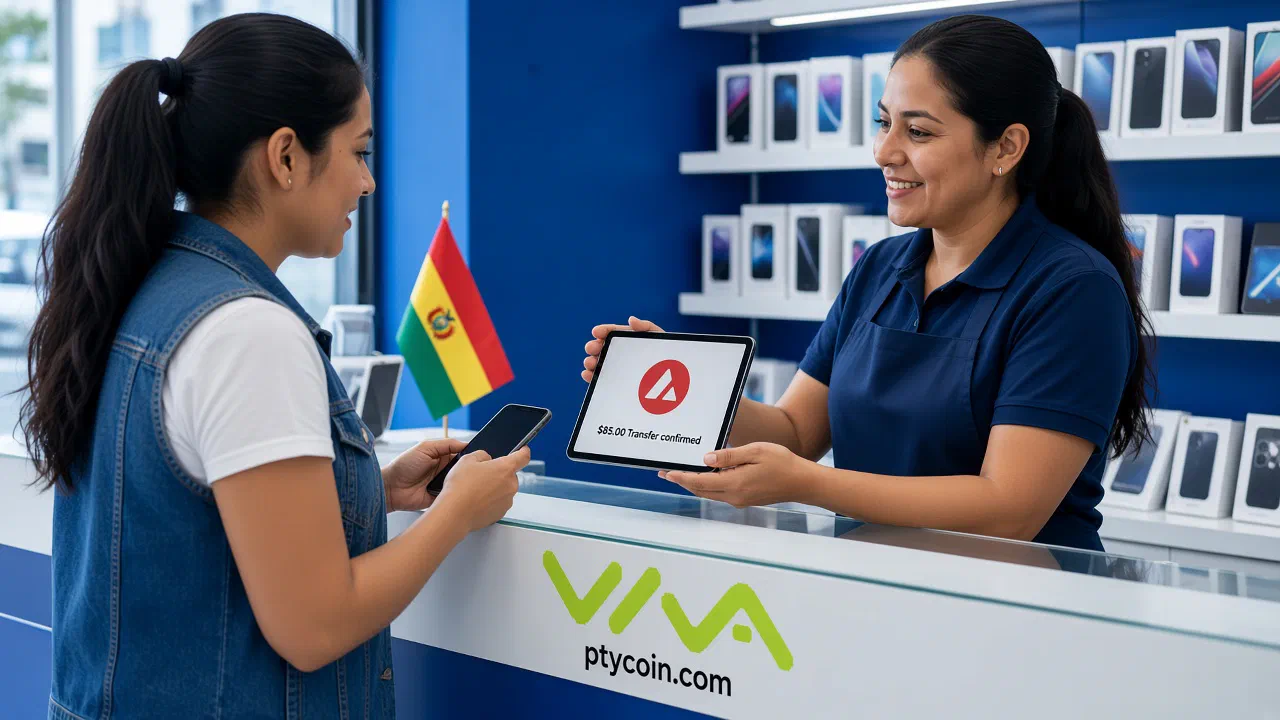
VIVA, the Bolivian telecom operator, is the first carrier live on Iris, an Avalanche-based financial network built for mobile operators, CoinDesk reported on 15 September 2026. VIVA is using USDi, a dollar-backed stablecoin issued by Agora, to settle activity and to hold eligible operating reserves in dollars rather than local currency.
DiarioBitcoin carried the same facts in Spanish the next day.
How a carrier plugs in
Iris is led by CEO Jules Miller, a former partner at IBM Blockchain Ventures who helped launch that firm’s blockchain investing group. She told CoinDesk Iris is “the financial network for telecom operators.” Carriers can connect the identity, billing, and distribution systems they already run, turn on services, and settle in U.S. dollars without replacing the core stack that keeps the telco running.
VIVA has operated in Bolivia for more than 25 years and recently expanded into Mexico, according to CoinDesk. That piece does not name a Mexico product, a public launch date for retail USDi, or a claim that customers already hold USDi wallets.
VIVA CEO Ryan Alvarez said in a statement: “We’ve invested heavily in modernizing our network and bringing our customers into the digital economy. Iris lets us earn new revenue on that investment and grow into a platform, without replacing the systems our business already runs on.”
Iris runs on a dedicated Avalanche Layer 1. CoinDesk says that design gives the network control over settlement, operations, and compliance. John Nahas, chief business officer at Ava Labs, told CoinDesk the first expansion push is Latin America and, potentially, parts of Africa and Asia rather than the United States.
“In the U.S. the operator is like one rail among many,” Nahas said. In markets such as Bolivia, “the mobile carrier is often the rail that people do everything on.”
Balesia’s $43 million commitment
Iris debuts with a $43 million commitment from Balesia Group, which CoinDesk describes as a family office with telecom businesses across the Americas. Use that word: commitment. CoinDesk does not publish a valuation, a close date, round type, or other limited partners.
Our Crypto Talk logged the same dollar figure and a split in the public framing. Avalanche’s official account posted that Iris “has raised over $40M.” CoinDesk, Iris, and Balesia stay with “commitment.” OCT also reports that Balesia pledged the money over three years.
Iris, citing McKinsey figures in the CoinDesk story, said global mobile data traffic grew more than 50% a year from 2012 through 2025 while operator service revenue grew less than 1% a year. The argument is that carriers already sit on customers, verified identities, and shops, assets that consumer-finance apps spend heavily to assemble.
Dollar reserves and one super-app comparison
For VIVA, using a dollar stablecoin for settlement also means the option to hold eligible operating reserves in dollars. CoinDesk flags that as relevant in markets where the local currency swings. USDi is the settlement asset in that account. Agora is named as the issuer. The CoinDesk story does not attach a reserve attestation, a token contract, or a public explorer ID for the Iris chain.
Nahas said a super-app product used by VIVA helped cut churn among prepaid mobile customers by 33% and raise their lifetime value by 35%. Those numbers are Nahas describing a VIVA product. They are not a measured return for Iris as a network. He added that Iris now needs more real-world case studies. “When you start to see numbers like this, it just starts making a lot of sense.”
Nahas also sketched a model in which the chain stays in the background: a telecom account can effectively become a wallet, and dollars can move as stablecoins. That is how he says the stack is meant to feel. It is not a report that VIVA’s retail base already holds USDi.
CoinDesk places Iris next to other corporate Avalanche work, including Hyundai Card’s USDT transfer to Hyundai Motor Mexico. Miller said she has looked for “real businesses doing real things that actually need blockchain,” and that Iris is talking with additional operators.
This is reporting on a carrier integration, not a recommendation to hold USDi, AVAX, or any telco’s shares.
Takeaway
VIVA is the first named carrier live on Iris. Settlement is described as Agora-issued USDi on a dedicated Avalanche Layer 1, backed at debut by a $43 million Balesia Group commitment. Nahas’s Bolivia line is the regional read: in that market the mobile operator is often already the rail. Read Krisztian Sandor’s CoinDesk report for the quotes, keep the 33%/35% pair tied to one VIVA super-app, and treat “raised over $40M” social copy as a looser frame than the commitment language.