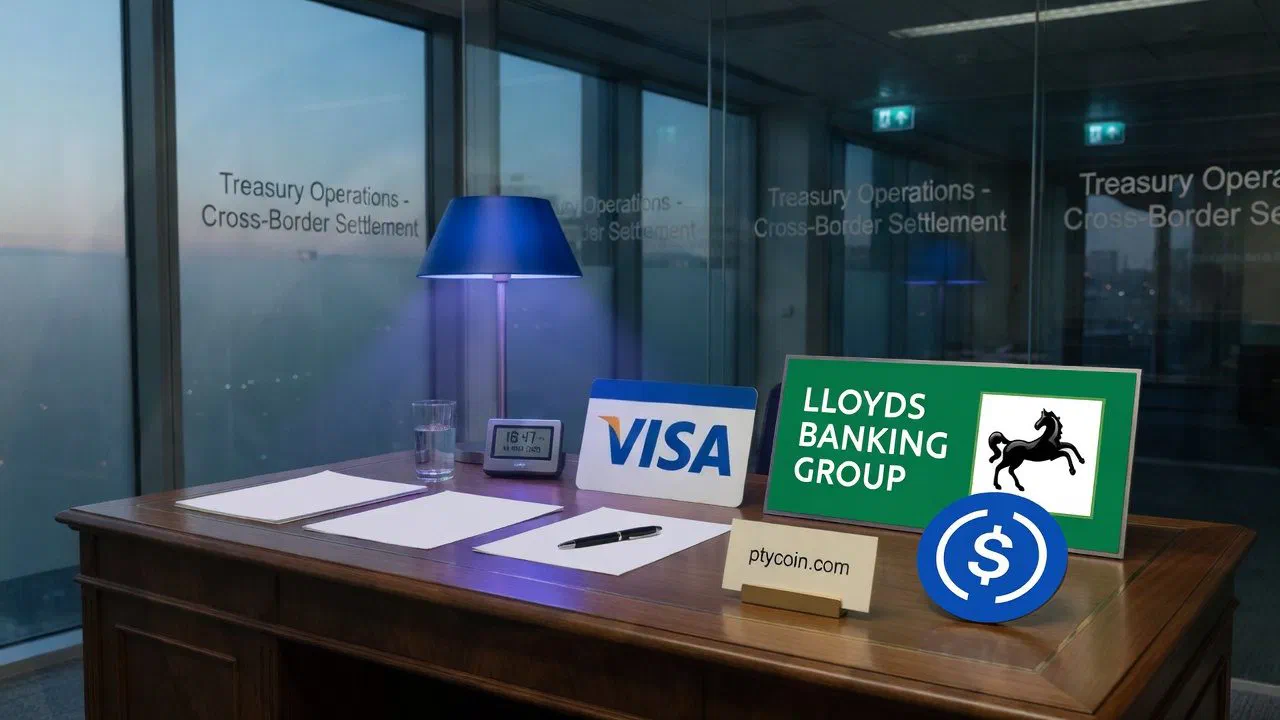
On 30 September 2026 in London, Lloyds Banking Group and Visa announced they had completed a seven-day live pilot that settled US$750,000 of payment obligations in USDC, with funds reaching Visa in under an hour, including over the weekend. The Block carried the same account on 1 October.
Visa’s release sets that hour against the old timetable. Under traditional cross-border processes, it says, settlement can take a day or more when the instruction starts outside banking hours. The pilot ran live dollar obligations through a stablecoin during a window that included the weekend.
What the two firms settled
Settlement is the step in which financial institutions exchange funds to complete and reconcile payment activity. Visa said the pilot focused on that step. It was not a new way for a cardholder or a merchant to pay. The release calls the trial the first stablecoin settlement test between Visa and a major UK banking group.
The book was a series of US dollar settlement obligations totaling US$750,000. Lloyds bought USDC through Archax, which Visa describes as a UK-regulated digital asset exchange. The volume was booked through Lloyds’ Corporate Markets branch in Jersey and transferred to Visa in the United States.
USDC is the stablecoin named for those dollar obligations. A stablecoin is a crypto token built to hold a steady value against a fiat currency. In this pilot the currency is the US dollar, and the token Lloyds bought was USDC.
A private Canton node and a public chain
The same obligations also crossed two blockchain environments. Lloyds used its own node on Canton and drew on what the release calls the network’s configurable privacy. Visa supported settlement on a separate public blockchain. The announcement does not name that public chain.
A node is the firm’s own connection to the network. Lloyds ran its own on Canton. Visa’s side of the same obligation settled on a public chain. The release says that split demonstrates interoperability across both networks, and that interoperability can help an institution access different networks while keeping reach, flexibility, and choice.
The operational result they published is specific: funds reaching Visa in under an hour, including over the weekend. Visa says round-the-clock settlement could give institutions a clearer view of when money has arrived, and could leave less liquidity tied up waiting for settlement to complete, particularly over weekends and holidays. Liquidity, here, is money a bank keeps committed until the transfer clears. The published test of that idea is the US$750,000 book.
What Lloyds and Visa said
Peter Left, head of digital assets at Lloyds Banking Group, said: “Settling $750,000 of live payment obligations between Lloyds and Visa using stablecoins has allowed us to move beyond theory and test these capabilities in a real-world setting.” He added: “We’re seeing how digital money could help make international payments faster, more transparent and more flexible for businesses.”
Rob Cameron, Visa’s group country manager for the UK and Ireland, said: “Businesses increasingly operate across borders and around the clock, but the infrastructure behind the movement of money has not always offered the same flexibility. This pilot with Lloyds shows how stablecoins can work alongside existing banking infrastructure to give financial institutions more choice over how and when they settle funds.”
The Block added one figure from outside this pilot. It reported that Visa’s stablecoin settlement volume surpassed a $20 billion annualized run rate last month. That line describes Visa’s broader settlement volume, as The Block stated it. It sits apart from the US$750,000 Lloyds moved here.
Where the announcement stops
Left’s point is that the obligations were live. The route was short and concrete: buy USDC through Archax, book it at Lloyds Corporate Markets in Jersey, deliver it to Visa in the United States, with Lloyds on its own Canton node and Visa on a public chain.
Visa said the pilot is part of Lloyds’ wider work to explore how digital assets and tokenized forms of money could enhance the movement of value between businesses and financial institutions. The release describes a finished pilot. It names no standing product, no follow-on amount, and no date when another bank could use the same route.
The result a reader can check is the one they measured. A major UK banking group and Visa settled live dollar obligations in USDC across a private Canton node and a public chain, with funds reaching Visa in under an hour, including over the weekend. Whether that hour still holds for a larger book, more banks, and more weekends is the question the announcement leaves open.