ONG Bitcoin Argentina marked five years of Escuelas y Bitcoin on the morning of Thursday, 24 September 2026, with an event in the auditorium of the Polo Educativo Saavedra in the City of Buenos Aires, held with support from the City’s Ministry of Education. It was called “El futuro del dinero y la economía” (the future of money and the economy), and according to the NGO’s pre-event release, the day was built around three themes: Bitcoin, wallets and cybersecurity.
In its LinkedIn recap the next day, ONG Bitcoin Argentina wrote that the venue “reunió a 350 estudiantes de 12 colegios, junto a docentes, talleristas y autoridades” (brought together 350 students from 12 schools, along with teachers, workshop leaders and officials), working with the Prácticas Profesionalizantes area of the City’s Ministry of Education. The post lists “charlas, juegos, actividades, preguntas y mucho intercambio”: talks, games, activities, questions and plenty of back-and-forth.
A free course for the last years of secondary school
Escuelas y Bitcoin is, in the words of its program page, a free training program on Bitcoin and blockchain, created by ONG Bitcoin Argentina for teachers and students in the final years of secondary school. Public and private schools can take part, and each one agrees with the NGO whether the classes run in person, online or in a hybrid format.
The NGO has been working since 2013. The release describes it as a nonprofit that promotes Bitcoin and decentralization through education, social innovation and community building. On its LinkedIn company page it lists three pillars: education, public advocacy and scam prevention.
Money first, then a wallet workshop
The core program has two sessions, according to the program page.
The first, “Bitcoin, Blockchain y nuevas formas de pago,” starts with money itself: what it is and how it has changed over time. Bitcoin then comes in as a technological innovation that proposes another way to organize the monetary system, with time spent on the problem it sets out to solve.
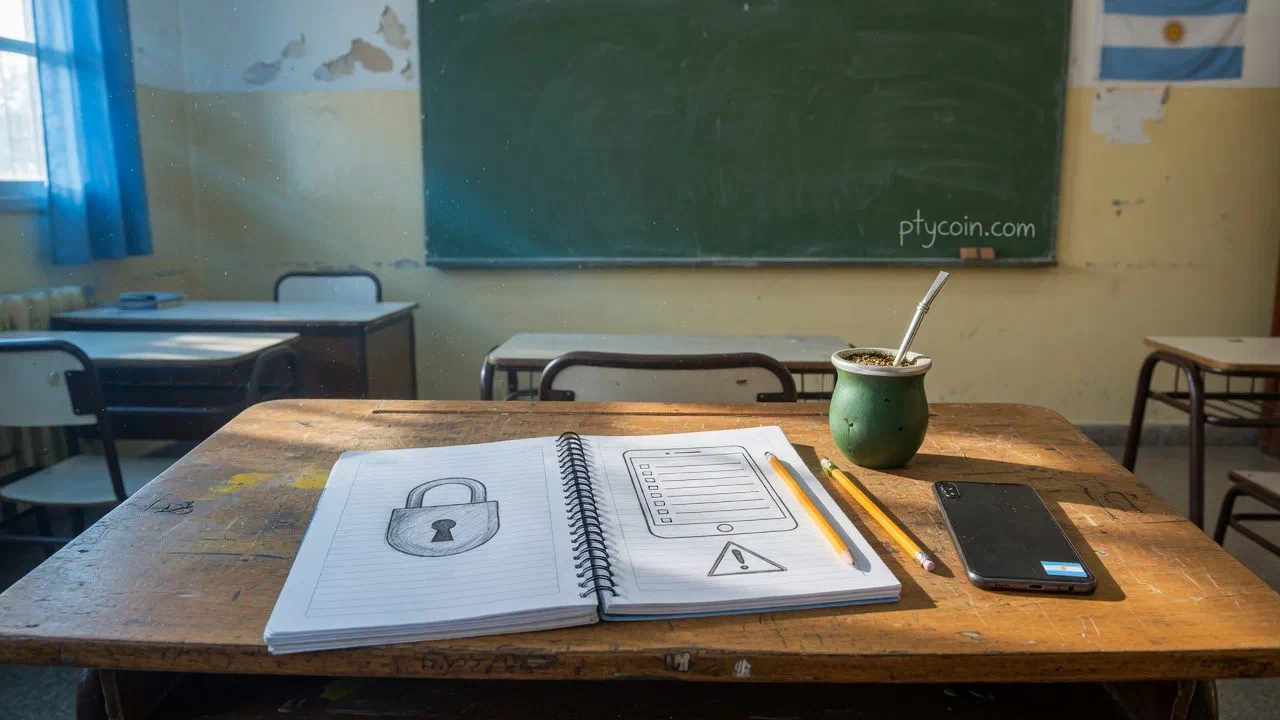
The second is a hands-on wallet workshop, the “Taller de Billeteras.” The page says it aims to show how Bitcoin is used, what basic precautions to take and how to operate safely, and that it covers the fundamentals of cybersecurity, privacy and scam prevention. Students also see a worked example of how satoshis, the smallest unit of bitcoin, circulate.
The NGO deals with scams outside the classroom too. Two days before the anniversary, it warned on LinkedIn about a sponsored article in Ámbito Financiero promoting a platform it called “de alto riesgo” (high risk). The NGO said it could not find independent sources for the platform’s claims, that the advertised returns showed warning signs it associates with possible fraud or Ponzi schemes, and that the outlet kept the piece online as sponsored content after the NGO raised the alarm.
Five years, by the NGO’s count
The release sums up the first five years: 80 implementations, 15,000 students reached “de manera directa e indirecta” (directly and indirectly), more than 80 workshop leaders trained and 20,000 kilometers traveled to reach schools around the country. Executive director Jimena Vallone gave the same totals in a LinkedIn post shared by the NGO, where the 15,000 appear as “personas capacitadas, directa e indirectamente” (people trained, directly and indirectly). Both versions fold in indirect reach, so the figure covers more people than the students who sat in a workshop.
For 2026 alone, the release says the program has reached 20 educational institutions and more than 500 students, in schools in the City of Buenos Aires and the provinces of Buenos Aires, Santa Fe, Misiones, San Luis and Entre Ríos. The September stops it names include two technical schools, EPET N° 51 in Misiones and Escuela Técnica N° 6 de San Martín in San Luis, as well as Escuela Secundaria N° 1 “Colonia San José” in Entre Ríos.
In her post, Vallone calls the program “gratuito y federal”: free, and federal in the Argentine sense of reaching schools across the provinces. She adds that the NGO trains its workshop leaders for free too, so they can carry the material back to their own communities and schools. The program page asks that those leaders be over 18, with training in education and finance and some teaching experience.
The people behind the classes
The release quotes three people behind the project. Vallone (translated from Spanish): “Escuelas y Bitcoin is one of the NGO’s projects that excites me most. I believe that creating these spaces for meeting and learning in school communities is fundamental to our mission.”
Federico Camargo, who coordinates the NGO’s training area, said marking five years alongside the City ministry’s Prácticas Profesionalizantes area consolidates the NGO’s effort to talk about the future of money and the economy in a way that is, in his words, “sencilla, neutral y accesible” (simple, neutral and accessible).
Project lead Paz Polli (translated from Spanish): “Our purpose is that students not only learn about Bitcoin, but also have tools that allow them to develop in their academic and working future.”
A curriculum anyone can read
Argentina has lived through long stretches of high inflation, and a free class that begins with the history of money and ends with how to keep a wallet safe is a practical offer for teenagers there. Vallone frames the goal as helping more people adopt these tools “de manera sana, informada y segura” (in a healthy, informed and safe way).
Anyone can read the curriculum on the program page, where one of the two core sessions is given over to wallet safety, privacy and scams. The NGO is now taking a separate university project on the road, with stops in Córdoba on 29 September and Mendoza on 1 October, according to CriptoPeriódico.
Funding disclosure: ONG Bitcoin Argentina says Escuelas y Bitcoin is supported by Paystand.org, Fundación Bitcoin Iberoamérica and Geyser. PTYcoin received no payment for this article, and nothing here is financial advice.
How we verified
On 1 October 2026 we checked the program page, the 16 September release as republished by Estamos en Línea, the NGO’s LinkedIn page and its posts of 7, 22 and 25 September, and the CriptoPeriódico report of 28 September. PTYcoin did not contact ONG Bitcoin Argentina for this article. All program figures are the NGO’s own and were not independently verified, and we found no independent press account of the 24 September event.