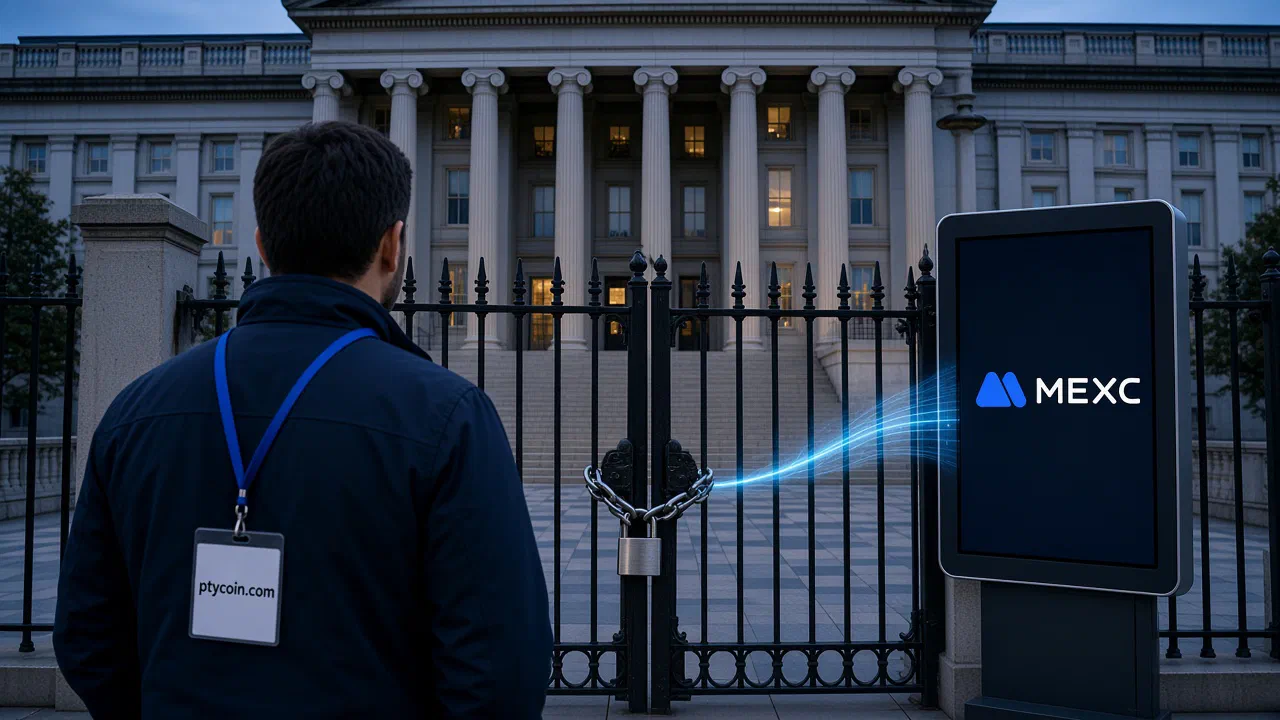
The Financial Crimes Enforcement Network has published an order that will bar covered U.S. financial institutions from sending funds to the Seychelles crypto exchange MEXC Global or receiving funds from it, crypto included. The ban will take effect on 10 December 2026, according to the Federal Register notice, and no closing date is named.
Treasury announced the step on 6 November, inside a campaign called Operation Economic Outcast, under section 9714(a) in the Combating Russian Money Laundering Act. FinCEN’s finding is that reasonable grounds exist to treat MEXC Global as a financial institution operating abroad and of “primary money laundering concern” on account of Russian illicit finance.
Who will have to stop the transfers
A covered financial institution means a financial institution under 31 CFR 1010.100(t). The rule includes a U.S. agent, branch or office of a bank and of a money services business. A money transmitter, one of those businesses, accepts value that stands in for currency and sends it on. FinCEN has long counted convertible virtual currency in that work, so a U.S. crypto business that does it falls under the ban.
The order’s definition of MEXC Global leaves out its U.S. branches, subsidiaries and offices. It covers the Seychelles exchange, its branches, subsidiaries and offices elsewhere, and any successor that buys its assets, in part or in whole, or carries on under a new name.
Funds in, funds out
Once that date arrives, a covered firm may not carry out a transmittal of funds from MEXC Global or to it. Transmittal means a send or a receipt, convertible virtual currency included. The order says that meaning stands in place of 31 CFR 1010.100(ddd), and that bitcoin stays covered even where it is legal tender in at least one jurisdiction.
The measure is not an OFAC sanctions designation. Bank Secrecy Act duties remain, reports of suspicious activity included, as do sanctions the Office of Foreign Assets Control administers. A willful breach can bring civil or criminal penalties, which 31 U.S.C. 5321 and 5322 set out.
The 16.7 billion U.S. dollars FinCEN cites
From May 2021 through May 2026, the order puts the sum at 16.7 billion U.S. dollars, tied to Russian illicit finance and other illicit activity, sanctions evasion and cybercrime among it. Its blockchain review sets direct and indirect exposure to Russian sanctions evasion at nearly 1.5 billion U.S. dollars. Of that, 232 million U.S. dollars were direct deals with parties listed by the United States, the European Union or the United Kingdom. Garantex and successor Grinex, both under sanctions, were still counterparties as late as June 2026. That review also names A7A5, a ruble-backed stablecoin.
FinCEN assesses that direct deals with more than 40 Iranian crypto exchangers, some sanctioned, exceeded 1 billion U.S. dollars in that window. It assumes a share of the activity is legitimate, says the lawful picture is incomplete, and assesses that illicit risk outweighs that share.
Where section 9714 can reach
According to CoinDesk, this is the largest exchange the section has been used on, and the section reaches a foreign institution only through Russian illicit finance, so that finding is the order’s formal basis. Treasury still announced it under Operation Economic Outcast, a campaign the report dates to August and describes as aimed at Iranian access to finance abroad. The report adds that MEXC had said the month before that service would end for people in Russia and in Belarus.
Inbound crypto a firm may not be able to refuse
A covered firm can block crypto it sends. Incoming crypto is different. In the order, FinCEN writes that the rails are often built so an institution other than the sender cannot refuse the coins before they land, and it assesses that workable ways to reject an inbound transfer ahead of receipt are few or none. A firm can still bar its own outgoing crypto to a given address or entity.
If coins arrive anyway, the order lets the firm use its discretion on the facts of each transfer, even when the sending address can no longer be reached. FinCEN gives two examples: coins that came from MEXC Global but sat a long time in an unhosted wallet, and a firm whose own risk procedures rule out sending funds back to MEXC Global. It says firms need no tools beyond the ones their anti-money-laundering programs already use.
Why FinCEN chose an order
Section 9714 permits an order, a regulation or another lawful route. FinCEN used an order, citing threats it calls imminent and transfers it says are still moving through the platform, tied to suspected activity around Russian illicit finance. It says covered firms will not face an undue compliance cost or burden. MEXC Global or any other party may send relevant information through FinCEN’s contact form.
Binance will refuse the sends
On 10 November Binance told users that the FinCEN finding leaves it unable to process transfers with the crypto platforms that finding covers. The notice lists MEXC and a dozen related names and affiliates, and asks users not to deal with any of them through Binance, directly or indirectly.
Sends from a Binance balance to a listed name will be refused. Deposits from a listed name will be held for a compliance review, and the account may be limited during it. Further limits under the terms of use can include removal from the platform. The notice gives no timeline. These steps are Binance’s own. The order itself will bind covered U.S. financial institutions.
MEXC says it is operating normally
On 7 November MEXC posted a statement. It knows of the 6 November order, it says, and is reading the text with counsel and compliance staff. “MEXC is operating normally, and user assets remain secure.” It says the concerns are taken seriously, that it intends to work with FinCEN and regulators elsewhere, and that an independent review of its money-laundering and sanctions controls is underway.
If your funds sit on MEXC
If you hold funds on MEXC, transfers with Binance and with a covered U.S. institution will be blocked or reviewed. Neither document tells you to sell, to withdraw or to stay.
This article is not investment advice.