
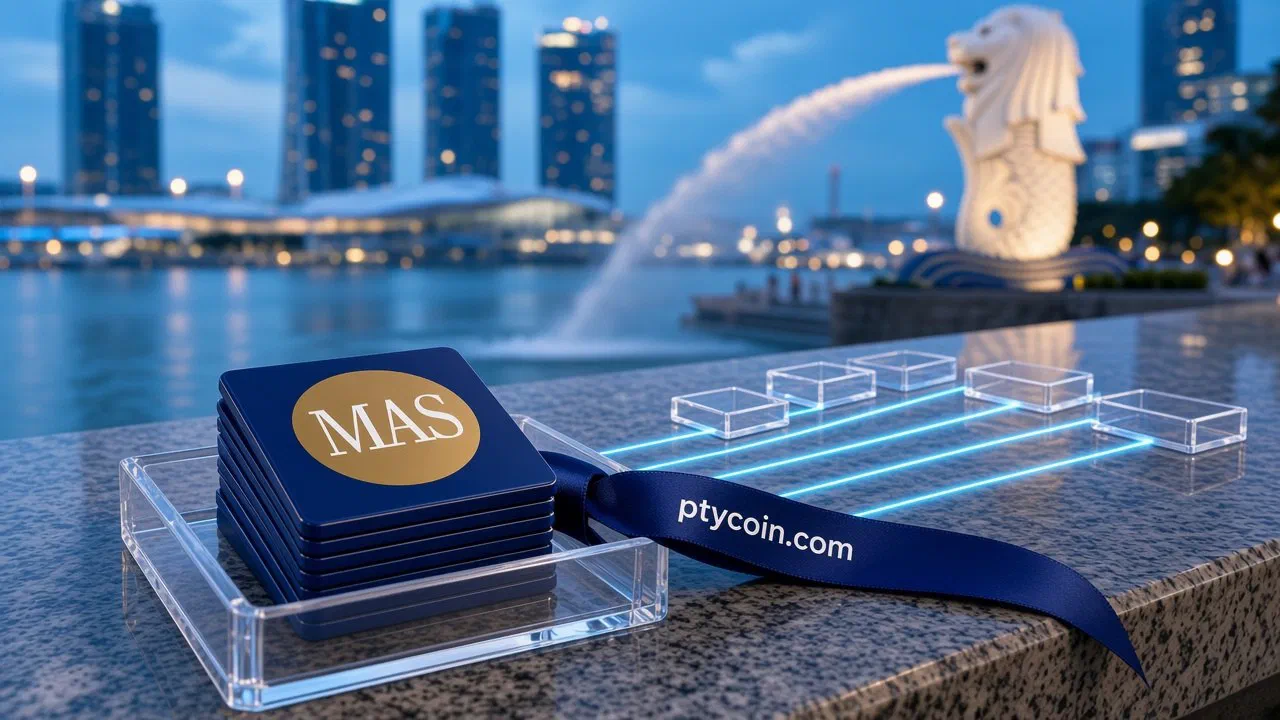
The Monetary Authority of Singapore, or MAS, sold S$100 million (100 million Singapore dollars) of four-week bills as tokens and settled that sale in wholesale central bank digital currency (CBDC). MAS issued them on 6 November 2026 on the Singapore Dollar Test Network, the shared ledger it operates. The bills come due on 4 December 2026. The authority published the result on 19 November 2026. Five primary dealers applied: DBS, HSBC’s Singapore branch, OCBC (Oversea-Chinese Banking Corporation), Standard Chartered Bank (Singapore) and UOB. Together the applications were more than double the issue.
Short-term Singapore-dollar paper, tokens from the start
A MAS bill is short-term debt of the authority, the paper banks use when they park Singapore dollars and manage that liquidity. Buyers of this issue receive no coupon. Only an institutional investor under section 4A of Singapore’s Securities and Futures Act may apply. The five bidders are primary dealers, banks MAS has approved to deal and make markets in Singapore government securities and in securities the authority itself issues.
Earlier tokenized sales, on the tokenized bill calendar, were much smaller. MAS issued S$1 million on 23 September 2026, maturing on 30 September 2026. It issued S$10 million on 9 October 2026, maturing on 23 October 2026. The latest issue is the largest so far. Every winning bidder pays the same clearing price.
MAS calls the latest sale native. The bills existed only as tokens from the start, and the test network is their sole record. MAS says that cuts out the reconciliation, and the middlemen, that come with tokenizing a bill after it has been sold the ordinary way. It presents the sale as building on a 2025 overnight interbank loan settled in wholesale CBDC: banks now have a Singapore-dollar asset they already trust, payable in that central-bank money, which MAS says opens a path to secured lending of tokenized assets on the test network. MAS flagged this step in October 2026.
Chia Der Jiun, managing director of MAS, said the live sale let the authority try a different method of issuing and improve the ledger its own staff maintains. In the next phase MAS intends to make later sales larger, bring more financial institutions in, and put the tokenized bills to work managing collateral. The authority wants tokenized securities to show up in ordinary market business, potentially settling trades more efficiently. Financial institutions, and firms that run market infrastructure, can ask to join trials MAS plans to hold live in 2027. “Over time, tokenised MAS Bills can play a complementary role to conventional MAS Bills,” he said.
Collateral on the same ledger
Wholesale CBDC is money the central bank issues so banks can pay one another. The public does not hold it.
A repurchase agreement, or repo, is a secured loan. One firm hands over high-quality paper, takes cash, and buys the paper back on a set date. Margin is the collateral a derivatives trade has to carry: the sum posted at the start, and the sum that changes while the trade is open. In his keynote at the Singapore FinTech Festival that same day, Chia said firms want to try doing this job with tokens, because collateral is where derivatives, secured borrowing and day-to-day cash management meet, and because moving it or posting it can be quicker and less costly once the asset is a token. A tokenized MAS bill puts paper banks already know on the same ledger as the central-bank money that would settle a repo or a margin delivery.
Chia said tokenizing that collateral changes the shape of the ownership record and the rails that carry a transfer from one holder to another. “It does not change the economic substance of the underlying financial asset,” he said. He set crypto assets apart. In MAS’s view, which he restated, a crypto asset has no cash, bond or fund underneath it and is a poor fit for retail buyers, while tokenized versions of ordinary instruments can still be useful in wholesale markets.
That day MAS and industry partners published the Guardian Tokenised Collateral Framework, written by firms and associations on the Guardian Tokenised Collateral Workgroup, among them DBS, UOB, Standard Chartered, UBS, SGX Group and ISDA. It covers repo between two parties and repo through a third-party agent, the opening and running margin on derivatives no central counterparty clears, and collateral posted to central counterparties, across eight steps of the collateral lifecycle. MAS convened the workgroup, and the report says it does not state MAS’s position.
SG Digital Ledger, still ahead
Chia said MAS will rename the test network SG Digital Ledger and reposition it as an operational utility, able to settle among institutions and to handle tokenized assets, several kinds of digital money and separate ledgers, with demand in the market deciding how widely firms join. He named no date for the switch.
The authority will work with industry, he said, to bring other collateral that banks already use onto tokens. That could mean foreign government bonds that trade widely, and money market funds.
He told the festival that tokenized financial assets are still small beside conventional markets. On 20 November 2026, Asia Fintech called the S$100 million small beside the ordinary volume of MAS bills. The bill calendar adds that the MAS bill statistics on the authority’s website leave the tokenized issues out.