
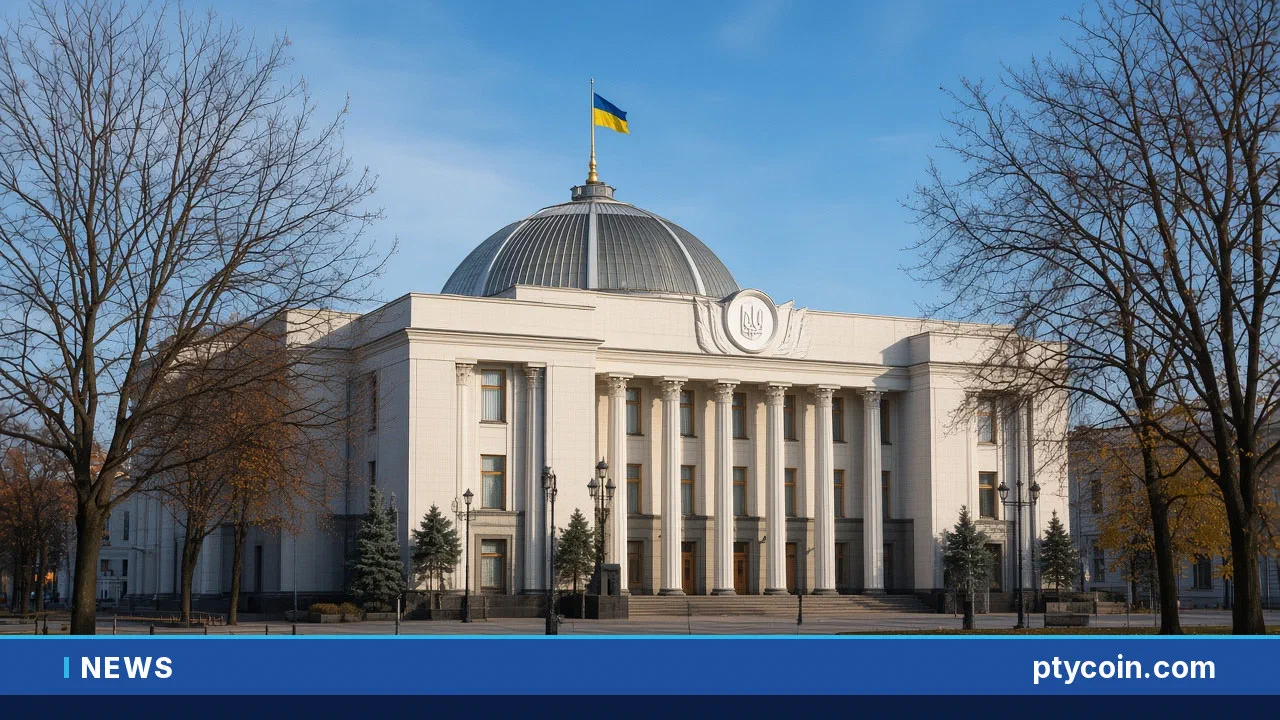
Ukraine’s parliament passed bill No. 10225-d on 25 November 2026, the text that would decide who may offer virtual-asset services and how holders are taxed. The press service of the Verkhovna Rada said the chamber took the draft through its second reading and adopted the whole text. The Rada’s record of the bill and its plenary log put that roll call at 11:16 Kyiv time, 09:16 UTC (4:16 a.m. ET): 271 voted yes, 8 voted no, 4 abstained and 32 did not vote. The president has not signed it, and nothing in the bill is in force. The main provisions are foreseen for 1 July 2027.
The draft amends the Tax Code and other laws that deal with virtual assets, and it splits supervision between the securities regulator, the National Securities and Stock Market Commission (NSSMC), and the National Bank of Ukraine (NBU). Companies would have to keep client property apart from their own. The release also covers tax on these transactions and what it calls the “so-called legalization” of virtual assets people already hold. It does not describe how that legalization would work.
Securities commission, central bank
The NSSMC, in a 25 November release, said it will admit participants and supervise them, inside the powers the text gives it. The central bank would cover some categories of virtual assets, plus monetary and financial stability. The commission’s next job is the secondary rulebook a supervised market needs.
The NBU press service, via Interfax-Ukraine, says the central bank would authorize and supervise firms that issue e-money tokens, along with providers that turn virtual assets into money. The NSSMC would handle every other service. The NBU said the final wording picked up its ideas for a real check on foreign tokens and for dropping some gaps and some artificial limits during authorization. The bank said the text follows the main approaches of MiCA.
Governor Andriy Pyshnyy said in Ukrainian, on 25 November, that the NBU expects system-wide rules to create the preconditions for a legal, transparent virtual-asset market, for greater trust in the participants, and for investment in the digital economy. He added that this market must not put Ukraine’s monetary sovereignty, the hryvnia or the banks at risk. The NBU, he said, will look hardest at e-money tokens, at payment use, at conversion into hryvnia, and at ties to ordinary finance.
On 4 November the NBU said it could not support the draft then circulating, and it named three risks: foreign tokens able to behave like e-money, uneven rules for foreign and Ukrainian assets, and a monopolization risk. That text left the NSSMC free to set the number of trading-platform operators for the first five years, even after the bank had accepted a compromise cap of three legal entities chosen by competition at the start.
Kyiv Post writes that Ukraine has lacked a law for virtual assets. An early note named the NBU, or a body the Cabinet would choose, as the only regulator. Lawmakers instead split the job. The finance committee cut a five-year power for the NSSMC to decide how many companies could clear trades and run trading venues. On Facebook, as the paper reported, Pyshnyy listed three late fixes: a check on foreign tokens, one rulebook for all players, and an authorization open to ownership checks, which he said makes Russian capital easier to keep out.
Rules for providers
Another Interfax-Ukraine story says deputies opened debate on 24 November and voted the next day. Exchanges, custodians and similar providers would need authorization, registration within 60 days, and a yearly file on residents’ deals. The agency calls that file an early move toward CARF and DAC8. While firms adapt, penalties would be much lower. Ads could not mislead, including pitches to spend crypto as money in Ukraine and any promise of a locked-in gain. Origin-of-funds checks and financial monitoring would tighten toward bank standards. People who flag breaches would receive legal protection.
Companies would get their own tax adjustments under that account. Issuing virtual assets and exchanging them would fall outside VAT. Providers of these services could not use the simplified tax regime.
A tax on the year’s profit
A person would owe tax only if the year produced a gain, and only at the usual rate on personal income. The account says the design copies how securities are taxed. Swapping one virtual asset for a different one would stay untaxed. So would a gain no bigger than a single minimum wage, and tokens that arrived with no payment. For holdings people already have, the account describes a bridge through the end of 2028, taxed at a reduced 5% rate of personal income tax.
CoinDesk sets the percentages out differently. Until 2028, it says, holders would face 5% plus a 5% military levy. From then on, the rate would be 18% plus that same levy. CoinDesk treats 18% plus the levy as the general rate. In the Interfax-Ukraine wording, the 5% is a transitional income-tax rate for assets already held.
Yaroslav Zhelezniak, a lawmaker, expects roughly 15 billion hryvnias, about US$330 million, to come into the budget. He did not say whether the sum covers one year or several. On Telegram, in CoinDesk’s English rendering, he wrote: “Finally we did what wasn’t possible for 35 years.” Danylo Hetmantsev, who chairs the tax committee, said the bill parliament passed will leave part of the illegal market in place, and that it still offers a lawful route for anyone who wants one.
Signature first
The text now waits on the president, and the NSSMC rulebook is still unwritten. Preliminary authorizations could start on 1 May 2027, according to the finance committee’s report, as cited by Kyiv Post. The commission foresees entry into force on 1 July 2027, matching the day the NBU press service gives for the main provisions.